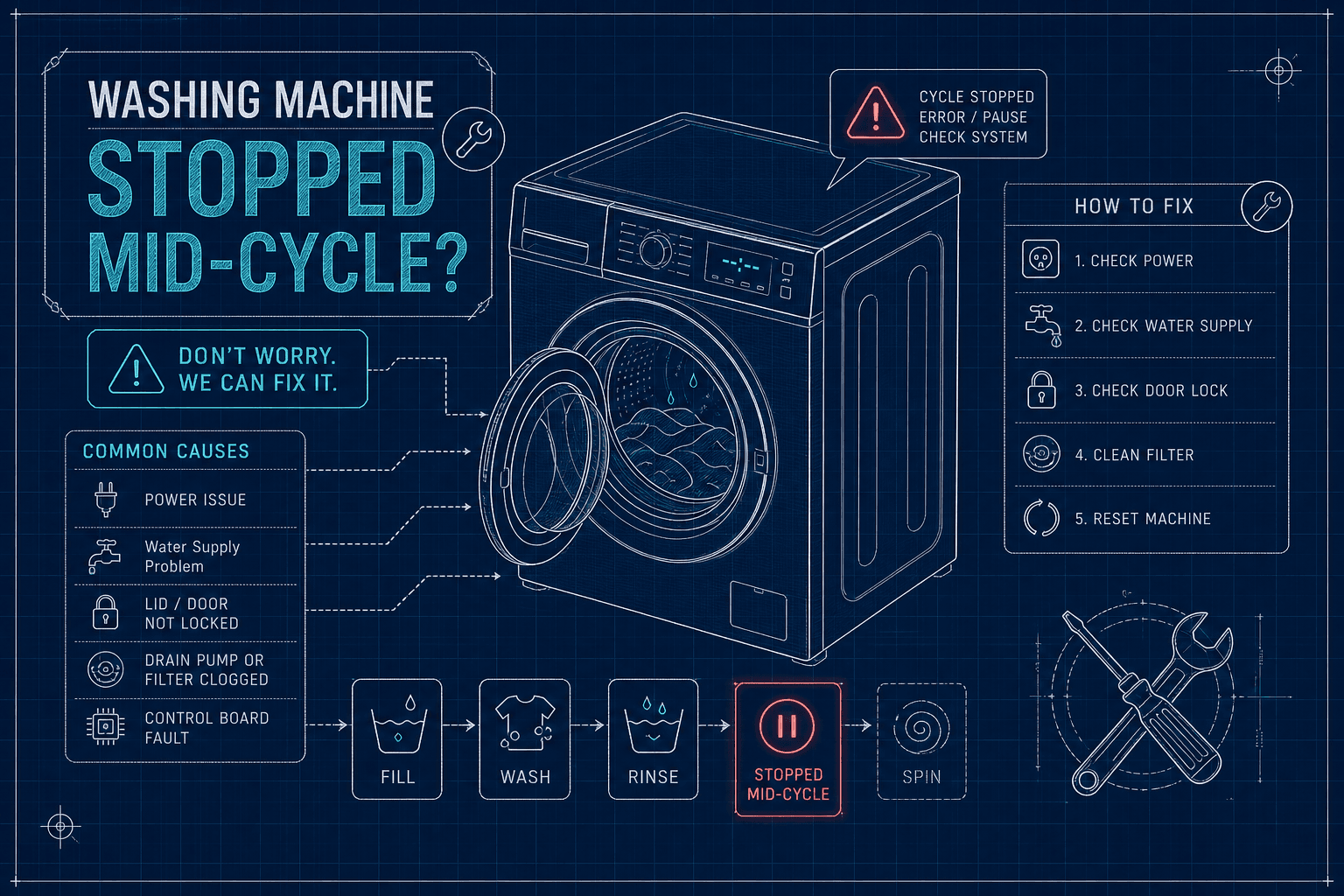
Wondering how do I fix a washing machine that has stopped working mid cycle? Discover common causes, troubleshooting steps, and practical fixes to get your washing machine running again.
How do I fix a washing machine that has stopped working mid cycle? You start a wash, walk away, and come back to find the machine dead, drum full of soaking clothes, display either blank or flashing something unhelpful. It's one of the more frustrating household faults because you can't just leave it. Most mid-cycle stops come down to a handful of causes, and many of them can be resolved at home in under 30 minutes without specialist tools, though results do vary by model and fault type.
This guide works through each fault systematically, from the simplest check to the more involved ones. The washing machine troubleshooting logic here reflects the approach the engineers at Alpha Appliances Ltd use in the field across London and the South of England. Start at the top, work down, and you'll either fix it yourself or know exactly what to tell a technician when you call. Note that model differences, warranty conditions, and complex faults may still require manufacturer service, consult your manual before any disassembly.
Mid-cycle stops are rarely random. The machine halted because a sensor or safety mechanism triggered, which is actually useful information: something measurable went wrong, and that means something measurable can be fixed. Based on typical repair call-out patterns, the most frequently reported culprits are drainage blockage and water supply issues (reported with roughly equal frequency), followed by power interruption, door lock fault, and an unbalanced or overloaded drum. For a concise checklist on common causes and quick fixes, see this guide on washing machines stopping mid-cycle.
The machine monitors drain status continuously throughout the cycle. If water isn't clearing fast enough, due to a blocked pump filter, a kinked hose, or a failing pump, the control board pauses the cycle automatically to protect the motor. Drainage is consistently one of the top causes of mid-cycle stops, and it's the fault most likely to leave standing water in the drum when you find the machine. A blocked filter is often around a 10, 20 minute fix. If an error code like E18 (Bosch), 5C/5E (Samsung), or E05/E20 (Beko) is showing, a washer that won't drain is almost certainly involved. For brand-specific error code help and common fixes, see Beko's troubleshooting article.
A tripped circuit breaker or loose plug can kill a cycle silently, with no error code displayed. The machine simply goes dark, and the natural assumption is that something internal has failed. It's worth checking the consumer unit and the socket before anything else. Similarly, a heavily unbalanced drum, most common with towels, bedding, or a single heavy item like a duvet, triggers an automatic pause as a mechanical protection measure. The machine attempts to redistribute the load, but sometimes it can't manage it alone.
Before pulling the machine apart, a proper power reset resolves control board glitches, false sensor readings, and unresponsive displays more often than you'd expect. The key distinction is between pressing pause on the panel and doing a full hard reset. Pressing pause just suspends the cycle; a hard reset clears the retained error state entirely.
Reset procedures vary by model, always check your manual if these steps don't match your machine's behaviour.
BrandReset stepsBekoSet programme dial to position 1 (cotton), hold Start/Pause, then turn the dial while holding.WhirlpoolHold Power/Cancel for 3, 5 seconds, then unplug for a full minute.SamsungFirmly close the door, then hold Start/Pause. Also clear the debris filter at bottom right before restarting.BoschHold Start/Reset for 3 seconds, then unplug for 5 minutes (longer than the standard one minute).ZanussiFollows the same logic as Electrolux models: hold Start/Pause for 3, 5 seconds to cancel, then power cycle.If the reset didn't resolve the fault and there's water sitting in the drum, the next step is to drain it manually and inspect the pump filter. This is the most impactful DIY fix for a washer that won't finish a cycle or complete a spin. You need a shallow tray or baking dish, several towels, and a coin. Set aside 15 to 20 minutes.
Many manufacturers provide emergency drain steps for front loaders; for example, Samsung's emergency drain instructions are useful if you need brand-specific guidance on using the emergency hose safely.
Most top-loaders don't have a front access panel for the filter. The practical option is to lower the drain hose from the back of the machine into a bucket at floor level and let the water siphon out by gravity. If that doesn't shift enough water, bailing from the drum with a jug works, though it takes longer. If the pump on a top-loader is fully blocked rather than just clogged with debris, professional access is usually required, as the pump sits beneath the drum and can't be reached without partial disassembly.
Front-loaders rely on an electronic door interlock to confirm the door is properly sealed before the drum spins or water fills. If this interlock is failing, the machine halts mid-cycle as a safety response. Many people assume a control board fault because the display may show nothing obviously wrong, but the interlock is the more common culprit and is worth checking first.
Start by cleaning debris from the latch recess: lint and detergent residue are the most common culprits and are easy to miss visually. Check that no laundry is snagged in the door seal, as even a thin strip of fabric can prevent the interlock from engaging fully. Run a drain-and-spin cycle to release any water pressure that may be holding the interlock closed, then try closing the door again with a firm single click. If the fault persists after these checks, or if a multimeter test shows no continuity on the door lock switch, the interlock assembly itself needs replacing. It's a straightforward part swap that a certified engineer can typically complete in under an hour, though the exact time varies by model.
If the reset, drain, filter clean, and door lock checks haven't resolved the fault, two more causes are worth ruling out before concluding the machine needs professional attention.
A kinked or blocked inlet hose, or a tap turned only partway on, prevents the drum from filling to the correct level. The machine pauses waiting for water and can look completely broken from the outside. Check both inlet hoses at the back of the machine for kinks, verify the tap is turned fully open, and inspect the small mesh filter inside the hose connection point for limescale or sediment buildup. This filter is easy to overlook but blocks up gradually over time, particularly in hard-water areas.
A single heavy item sitting on one side of the drum, a duvet, a large jumper, or a pair of jeans, causes vibration beyond the sensor threshold. The machine pauses automatically and attempts to redistribute the load through short reverse-direction spins. When it can't redistribute successfully, it stays paused to avoid damaging the drum bearings or suspension. Opening the door, spreading the laundry evenly by hand, and restarting solves this entirely without any repair work.
If none of the steps above have resolved the fault, the machine has an internal problem that needs a trained engineer with the right diagnostic tools and parts. The most likely causes at this point are a failed drain pump, a faulty main control board, a broken door interlock assembly, or a worn motor. These aren't safe or cost-effective for most homeowners to tackle without formal training.
Alpha Appliances Ltd offers next-day availability across Greater London, Berkshire, Surrey, Hampshire, and Dorset, with City & Guilds certified engineers and a 78% first-time fix rate (based on internal service data). Every visit is fixed-price with no hidden call-out fees. For customers with high-end appliances or machines still under warranty, their manufacturer-trained technicians use genuine parts and issue a full service report on completion. For more detail on coverage and services, see Expert Washing Machine Repairs across London.
When you need an engineer quickly, not in two to four weeks, Alpha Appliances Ltd offers fast turnaround with the same level of certified expertise, without the extended call-back queues. That matters when you've got a drum full of wet laundry and a household that can't wait. We also provide local support in central neighbourhoods, for example, check our expert repair services in Brompton.
If you're still asking how do I fix a washing machine that has stopped working mid cycle, the answer is to follow the sequence: check power and reset first, then drain and clear the filter, then inspect the door lock, then check the water supply and load balance. Many mid-cycle stops resolve at the first two stages. Basic washing machine troubleshooting of this kind commonly takes 10, 30 minutes and requires no specialist tools, though timing depends on your model and the specific fault.
If none of these fixes work, the machine has an internal fault that needs a trained engineer. Booking a repair early is often cheaper than a full replacement, particularly on machines that are roughly 10 years old or less, though it's worth getting a quote to compare. A washing machine that stops mid-cycle is rarely beyond repair. It usually just needs the right diagnosis.
For customers across London and the South of England, Alpha Appliances Ltd is a fast, reliable route from fault to fix. Residents in Hackney can find local help via our Hackney Appliance Repair Experts Ready to Assist. Book online and get a confirmed engineer visit, typically the next working day.
Book a visit from a certified Alpha engineer in minutes.
TRUSTED BY HOMEOWNERS
Fast, reliable, and warranty-backed repairs for every major brand.
Discover more tips from Alpha engineers.