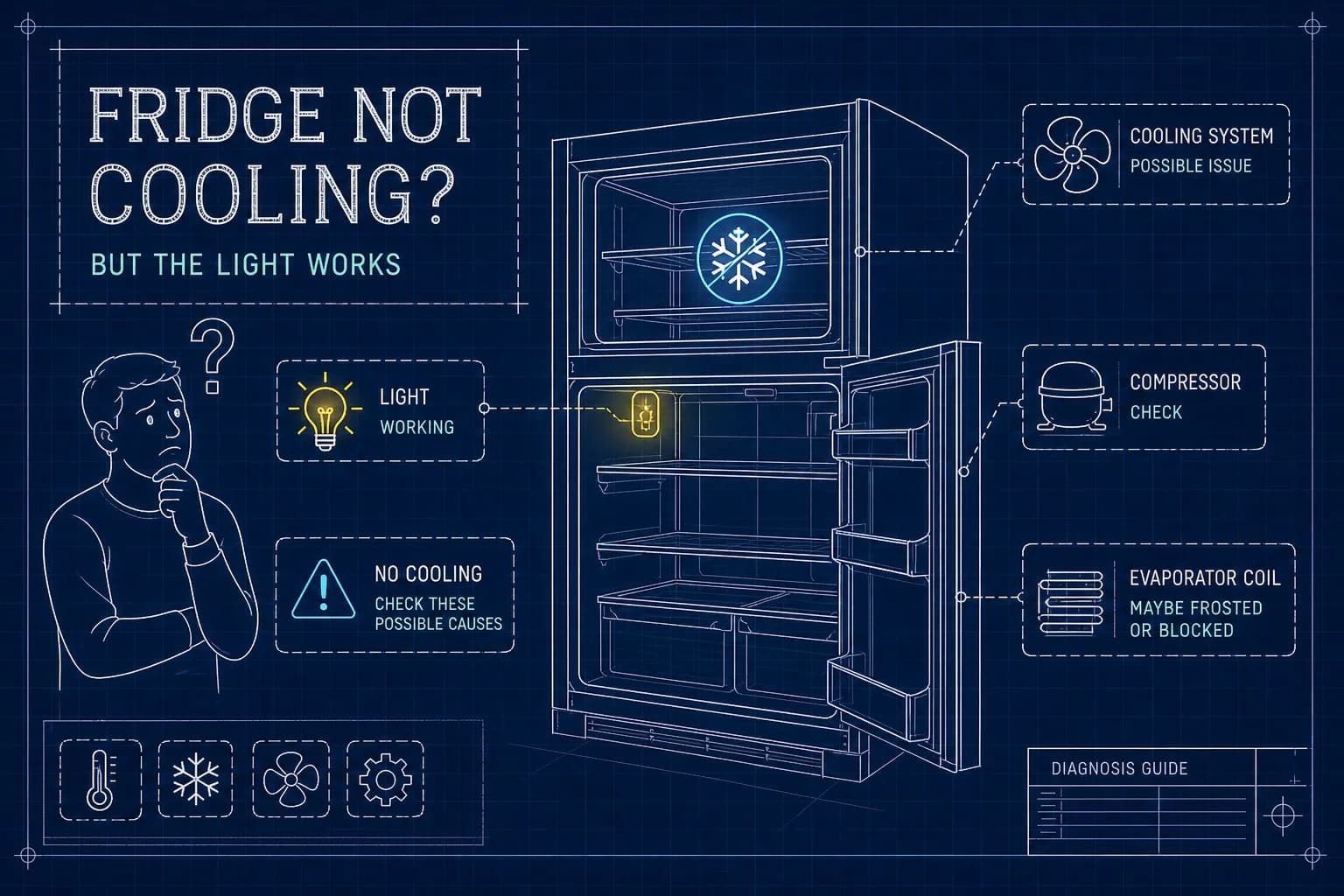
Discover why your fridge freezer isn't cooling while the light stays on. Learn quick DIY checks, common faults, and when to call a pro to save food.
If your fridge freezer is not cooling but the light is on, you are dealing with a highly specific and diagnosable fault. You open the door, the light flicks on, everything looks perfectly normal. Then you notice it: the milk is warm, the butter has softened, and what was ice cream is now a lukewarm puddle. It is a deeply unsettling discovery, especially when the appliance shows no obvious sign of trouble. The display is on, the light works, so what on earth has gone wrong?
The reassuring news is that this is not a random breakdown, and it does not automatically mean the appliance is beyond saving. It is a fault our engineers at Alpha Appliances Ltd see several times a week, and the cause is almost always one of a handful of identifiable components. This guide walks through each of them in a logical order, starting with what you can check yourself right now.
A fridge freezer contains two distinct systems working independently of each other. The electrical system powers the interior light, the control display, the fans and the control board. The refrigeration circuit is a sealed loop of compressor, condenser coils, evaporator coils and refrigerant that actually generates the cold. When the light works but the fridge is warm, the electrical system is functioning perfectly. Something inside the refrigeration circuit has stopped doing its job.
This distinction is genuinely good news for diagnosis. It narrows the field considerably and rules out the most catastrophic type of failure: a total electrical breakdown. You are looking at one of a short list of components, most of which are identifiable without specialist tools.
The interior light connects directly to the door switch and the main power supply. Its only function is to illuminate the cabinet when the door opens. It tells you nothing about whether the compressor is running, whether the fans are turning, whether there is sufficient refrigerant charge, or whether the defrost cycle is operating. Think of it like the interior light of a car staying on after the engine has seized: the battery is fine, but the car is not going anywhere.
The compressor pumps refrigerant around a sealed loop. That refrigerant absorbs heat from inside the cabinet at the evaporator coils, carries it out to the condenser coils at the back or underneath the unit, and the cycle repeats continuously. Two fans assist this process: the evaporator fan circulates cold air through the cabinet, and the condenser fan draws air over the hot coils on the outside. If any single component in this loop fails, the entire cooling process stops, even while the light carries on working without interruption.
The following causes are ranked from most common and easiest to address through to more serious faults that require professional attention. Working through them in order gives you the best chance of locating the problem before you do anything hands-on.
Condenser coils caked in dust, pet hair and kitchen grease cannot release heat efficiently. When they cannot shed heat, the refrigerant stays warm and loses its ability to absorb heat inside the cabinet. This is one of the leading causes of a fridge freezer not cooling, and it is entirely preventable with basic maintenance. Equally, overstuffing the fridge or pushing food against the rear wall blocks the internal air vents that circulate cold air between the freezer and fresh food compartments, leaving the fridge section warm even when the freezer is still performing. Manufacturers and repair guides offer similar diagnostics for a refrigerator not cooling.
The evaporator fan sits inside the freezer compartment, typically hidden behind a rear panel. If it stops running, cold air produced at the evaporator coils stays trapped there and never reaches the rest of the cabinet. The condenser fan sits near the compressor at the back of the unit; if it fails, the compressor overheats and cuts out on its thermal overload protector. In both cases, the fridge has power and the light works, but cooling stops entirely. Listening for fan noise when the doors are closed is one of the first and most informative checks you can carry out.
A faulty thermostat or thermistor (temperature sensor) can signal to the control board that the fridge is already cold enough, preventing the compressor from starting a cooling cycle even when the cabinet is warm. A worn start relay (a small component mounted on the side of the compressor) can stop it from starting at all. The tell-tale sign of a failed start relay is a clicking sound every few minutes as the compressor tries and fails to initiate. These parts are relatively affordable and, depending on the model, sometimes straightforward to replace without specialist tools.
Before you touch anything on the appliance itself, your first priority is the food inside it. Everything else can wait a few minutes.
The UK Food Standards Agency advises keeping fridge contents at or below 5°C and frozen food at or below -18°C. If your fridge has been warm for more than two hours, high-risk perishables including cooked meats, fish and dairy need your attention immediately. Move anything time-sensitive to a cool bag with ice packs or a neighbour's fridge. Keep the door closed as much as possible: an appliance that has lost cooling will retain residual cold for longer if it stays shut. Check use-by dates on anything that has been sitting in a warm cabinet before deciding what to keep. For practical tips on preventing food spoilage during an outage, see recognised guidance on handling perishable food.
Pull the unit away from the wall and examine the condenser coils at the back or underneath. If they are visibly coated in dust or debris, use a vacuum cleaner with a soft brush attachment to clean them thoroughly. Inside the cabinet, check that no food packaging is pressed against the rear wall or covering the grille vents between the freezer and fridge sections. These two checks alone resolve a surprisingly high proportion of calls we receive about a fridge freezer not cooling, and they cost nothing but a few minutes of your time.
Close the freezer door and listen carefully: you should be able to hear the evaporator fan running. If the freezer is completely silent, the fan may have failed, or a solid layer of ice may be obstructing the blades. Open the freezer and inspect the rear wall: if it is encased in a thick layer of frost or solid ice, the defrost system has almost certainly failed. At the back of the unit, check whether the condenser fan near the compressor is spinning; a blade that will not turn by hand indicates either a seized motor or a physical obstruction that can be cleared.
The defrost system runs automatically every several hours to melt the frost that naturally accumulates on the evaporator coils. If it fails, frost builds up layer by layer until the coils are completely encased in ice, choking off airflow and stopping the cabinet from cooling. A fridge freezer that has gradually become warmer over days or weeks, rather than failing suddenly, is a strong indicator of a defrost fault, one of the more common reasons a fridge freezer is not cooling but the light is on.
Remove the food from the freezer and take off the interior rear panel, usually held in place by two or three screws. If the evaporator coils behind it are buried in ice rather than showing bare metal, the defrost system has stopped working. You may also notice the evaporator fan is running but producing more noise than usual, because the blades are partially obstructed by ice. A cabinet that has lost cooling gradually over several weeks rather than stopping abruptly is the clearest behavioural indicator of this fault.
With the appliance unplugged, the defrost heater (a glass or aluminium tube wound around or beneath the coils) can be tested with a multimeter set to the resistance or continuity function. A working heater will show continuity; an infinite resistance reading confirms it has burned out. The defrost thermostat, sometimes called the termination switch, can be tested the same way after placing it in a cup of iced water for a minute: it should show continuity when cold and open-circuit when warm. If either component fails these tests, the parts are widely available and within DIY territory for a confident home repairer, though a qualified engineer will complete the work faster and fit the correct replacement part first time.
If the coils are clean, both fans are running, there is no ice on the evaporator, and the thermostat settings are correct, the fault most likely lies in the sealed refrigeration circuit. This means either the compressor itself, a failed start relay, or a refrigerant leak. These faults are beyond the scope of DIY, and it is important to understand why before attempting anything further.
A compressor that runs continuously but produces no cooling, or a cabinet that is uniformly warm with no obvious fan or defrost fault, are both strong indicators of a sealed system problem. An oily residue on the floor or pipework beneath the unit points toward a refrigerant leak. A faint chemical smell near the appliance is another strong indicator of a sealed system issue. If you can hear the compressor humming but the cabinet temperature never drops, the compressor may be running but failing to pump refrigerant effectively. For step-by-step checks when the motor seems to be running but the unit is not cooling, see compressor not running troubleshooting.
Under the UK F-Gas Regulations, handling, recovering or recharging refrigerant in domestic appliances is only legal when carried out by an F-Gas certified engineer. Attempting to top up refrigerant yourself is both illegal and genuinely unsafe: the gases involved can cause respiratory irritation, and incorrect handling can destroy the compressor entirely. Releasing fluorinated greenhouse gases into the atmosphere is a criminal offence under UK law. If your fault diagnosis points here, the right move is to contact a certified engineer without delay.
The team at Alpha Appliances Ltd carry full F-Gas certification alongside their City and Guilds qualifications. They offer a fixed-price diagnostic visit with same-week repair slots across London, Berkshire, Surrey, Hampshire and Dorset. If the compressor is repairable, the cost is confirmed in full before any work begins, so there are no surprises on the invoice. For straightforward booking and details of our professional fridge freezer repair service, visit our service page.
A general guideline used across the appliance repair industry is this: if the repair cost exceeds 50 per cent of the price of a comparable new appliance and the fridge freezer is more than eight years old, replacement is usually the better investment. Fan replacements, defrost heaters and thermostats typically sit well below that threshold. Compressor replacements sit closer to the boundary, particularly on budget appliances. Sealed system refrigerant work on a high-end appliance, however, often makes clear financial sense where the replacement cost of the unit runs well over £1,500.
The biggest mistake homeowners make is calling out a repair company without first narrowing down the fault. A trustworthy engineer will charge a fixed call-out fee, diagnose the fault on the first visit, and confirm the repair cost before touching a single component. That transparency is what separates a reliable repair service from one that runs the bill up on guesswork. If your DIY checks have pointed to a fan, a defrost component, or a possible compressor issue, booking a diagnostic visit from a certified engineer is the logical next step: it removes uncertainty, protects the appliance from further damage, and gives you a clear decision point on repair versus replacement.
A working interior light confirms one thing only: the electrical supply is reaching the appliance. The cooling circuit is a completely separate system, and working through the causes in order is the fastest way to find the fault. Start with the easy checks: clean the condenser coils, clear the air vents, listen for fan operation, and inspect the freezer for heavy ice build-up. Many faults that leave a fridge freezer not cooling while the light stays on are resolvable in under an hour with a vacuum cleaner and a screwdriver.
If those checks do not resolve the problem and the fault points toward the compressor or sealed refrigeration system, stop there and contact a certified engineer. Acting promptly protects your food and limits the risk of secondary damage to the appliance. The sooner the fault is identified, the less likely it is to escalate into a more costly repair. If you are based in London or the South of England, the Alpha Appliances Ltd team is available for same-week bookings through their online booking system, with transparent fixed pricing from the moment the engineer arrives. We also offer focused local repairs, including Fixing De Dietrich Fridge Freezers in Aldwych Fast and specialist work on Haden fridge freezers in Aldgate.
Book a visit from a certified Alpha engineer in minutes.
TRUSTED BY HOMEOWNERS
Fast, reliable, and warranty-backed repairs for every major brand.
Discover more tips from Alpha engineers.