
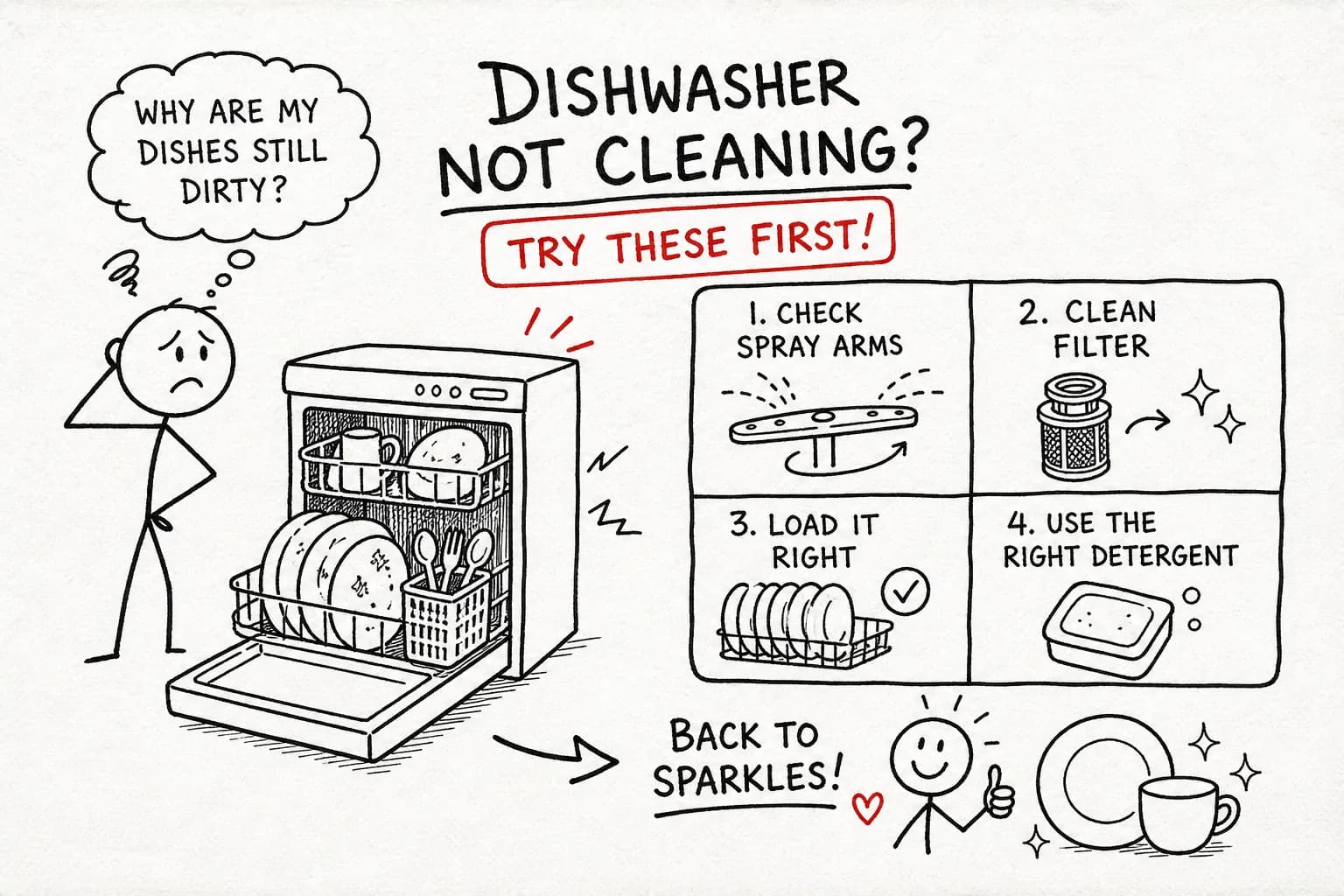
Dishwasher not cleaning dishes? Try these fixes first
If your dishwasher is not cleaning dishes properly, you're likely dealing with one of five common faults, and most can be resolved without specialist tools. You run it overnight, unload it in the morning, and there they are: greasy plates, cloudy glasses, and dried-on food the machine clearly never touched. It's one of the most frustrating things a kitchen appliance can do. The good news is that a dishwasher not cleaning is almost always caused by one of five fixable things, and many of these checks can be completed within 30 minutes.
The engineers at Alpha Appliances Ltd attend dishwasher callouts across London and the Home Counties throughout the year. Before they open a single panel or run a diagnostic, they work through the same five checks every time. That's exactly what this guide covers, in the same order, so you can identify the problem and fix it yourself before deciding whether a professional repair is needed.
Start with the spray arms. They're a frequently overlooked cause of dirty dishes after a cycle, and they're the easiest to clear.
Dishwasher not cleaning? Blocked spray arms are often the first thing to check
Your dishwasher has two or three spray arms: one beneath the lower rack, one beneath the upper rack, and sometimes a third fixed to the top of the tub. Each arm spins during the wash cycle and fires pressurised water through small nozzle holes to reach every surface in the machine. When those holes become clogged with food debris, mineral deposits, or occasionally a fragment of broken glass, the spray pattern breaks down and sections of every load come out dirty.
To clear them, pull out both racks for access. Most spray arms twist off or unclip without tools, check your model's manual if yours isn't immediately obvious. Hold each arm under warm running water and use a toothpick or thin piece of wire to push through every nozzle hole individually. If limescale is present, the white chalky crust around the holes will crumble away as you work. For heavier mineral buildup, soak the arm in warm water with a splash of white vinegar for 15 to 30 minutes before rinsing again; citric acid-based solutions work well too. Once cleaned, reinstall each arm and spin it by hand to confirm it moves freely without catching.
If the plastic casing is cracked, the holes are visibly deformed, or the arm wobbles loosely on its mount rather than sitting securely, cleaning won't fix it. Replacement arms vary in cost depending on model and supplier, so check part prices for your specific machine before ordering. Fitting them correctly to ensure the right spray pressure matters, so if you're in any doubt, that's a job for a certified engineer.
Dishwasher not cleaning properly? Check the filter first
Many homeowners don't realise their dishwasher has a filter, let alone where it sits or that it needs regular cleaning. It's one of the most common causes of a dishwasher leaving dishes dirty, and one of the easiest to resolve once you know what you're looking for.
On many modern dishwashers, the filter sits in the floor of the tub, directly beneath the lower spray arm. It usually consists of a cylindrical inner filter and a flat mesh plate around it. Twist the cylinder anticlockwise and lift it straight out, no tools required.
Rinse the filter under warm running water to remove loose food debris. For grease and trapped food residue that won't shift under running water, work over it gently with an old toothbrush and a small amount of washing-up liquid. Do not use scouring pads or abrasive cloths, as these damage the fine mesh and reduce filtration performance. Rinse thoroughly before refitting, making sure the cylindrical section locks back into position with a firm clockwise twist.
How often this needs doing depends on how much you use the machine. In hard water areas or households that skip the pre-rinse, clean the filter every two weeks. For average use, once a month is enough. If the dishwasher has progressively got worse at cleaning over several months, a blocked filter is almost certainly part of the reason.
How you load the dishwasher affects how well it cleans
Loading habits account for more poor cleaning results than most people realise. The spray arms work by rotating and directing pressurised water across the load, so anything that interrupts that rotation or blocks the path of the water jets will leave dishes dirty. A cutting board or large pan propped upright in the lower rack can stop the upper spray arm from spinning entirely, which means the top rack goes effectively unwashed.
The most common loading mistakes are easy to avoid once you know what causes the problem:
- Tall items in the lower rack blocking the upper spray arm's rotation
- Cups and bowls placed facing upward, pooling water rather than deflecting it
- Plates stacked too closely together so water can't reach the surfaces between them
- Cutlery nested together in the basket rather than mixed, shielding surfaces from the spray
- Long-handled utensils hanging down through the rack and catching the lower spray arm
Load plates angled inward toward the spray arms, with dirty surfaces facing the centre of the machine. Glasses and cups go inverted and spaced apart so water runs off freely. Pots and pans belong on the lower rack, facing downward. Before you start a cycle, reach in and spin both spray arms by hand to confirm nothing is obstructing them. A well-loaded machine cleans dramatically better, and that improvement costs nothing and takes seconds.
Low water temperature and limescale buildup reduce cleaning power
Detergent enzymes need heat to work properly. Water that isn't hot enough means grease stays on dishes and tablets don't dissolve fully. The ideal incoming water temperature for a dishwasher is around 49 to 60°C. To check yours, run the hot tap nearest the dishwasher for 60 seconds, fill a glass, and measure the temperature with a kitchen thermometer. If it reads below 49°C, the boiler thermostat may need adjusting. For most UK homes, a combi boiler set to around 55 to 60°C for the hot water supply hits the right range.
In hard water regions such as London and Surrey, limescale compounds this problem significantly. Mineral deposits build up on the heating element, spray arm nozzles, and interior walls, reducing cleaning efficiency and eventually damaging components. In these areas, limescale can become visible within weeks on an unprotected machine. Descaling every one to three months is the right preventative frequency.
To descale safely, empty the machine completely and remove and rinse the filter. Wipe the door seal and interior edges with a soft cloth. Place a commercial dishwasher descaler or a citric acid-based product in the tub as directed by the product label, then run the hottest full cycle available. Do not use bleach and vinegar together. The combination produces toxic fumes. Abrasive pads and steel wool are also off the list, they scratch stainless steel and damage the door gasket.
Detergent and rinse aid mistakes that cause a dishwasher not cleaning properly
Tablets and pods outperform gels in most independent tests because they combine enzymes, degreasers, and rinse agents in a single pre-measured dose. Detergent must always go into the dispenser drawer, not loose in the tub. When placed loose, it dissolves during the pre-wash before the main cycle begins, which means the machine runs the actual wash with no detergent at all. Old or damp detergent also loses effectiveness, so buying in bulk and storing it for months is a false economy.
Rinse aid is dispensed during the final rinse phase, where it helps water sheet off surfaces cleanly rather than drying in droplets. Without it, glassware develops a cloudy film and plastic items tend to come out wet even after a full cycle. If dishes still show spots or a greasy film after adding rinse aid, check the dose setting on the machine, most dishwashers allow you to increase the amount dispensed per cycle through a dial inside the rinse aid compartment.
In hard water areas, use the maximum recommended detergent dose per load and keep the dishwasher's built-in water softener topped up with dedicated dishwasher salt. This step is often overlooked in UK households. Without salt, the water softener stops working, hard water minerals aren't removed, and both cleaning performance and limescale protection drop sharply.
Dishwasher not cleaning after all five checks? When to call an engineer
If you've worked through all five checks and the machine is still producing dirty dishes, the fault has moved beyond basic maintenance. The most common mechanical culprits at this stage are a failing circulation pump, a faulty inlet valve, or a broken detergent dispenser door spring.
A failing circulation pump produces noticeably weaker water pressure at the spray arms, which often shows up as a humming sound during the wash phase without the usual rushing-water noise. A faulty inlet valve limits how much water enters the machine, so the tub never fills to the level needed for an effective wash. A broken dispenser door spring means the tablet compartment doesn't open mid-cycle, leaving the detergent tablet sitting undissolved until you unload the machine. None of these are safe or straightforward DIY repairs.
Alpha Appliances Ltd sends City & Guilds certified engineers across London, Surrey, Hampshire, and Dorset, typically on a next-day basis. Every repair is fixed-price with honest diagnostics from the first visit, so there are no surprise charges once the work is done. Most dishwasher faults are resolved in a single appointment, which avoids the longer lead times typical of manufacturer service teams.
Run through these checks before you do anything else
A dishwasher not cleaning properly is, in the vast majority of cases, entirely fixable. Work through the five checks in order: clear the spray arms, clean the filter, correct your loading habits, test the water temperature and descale if needed, and review your detergent and rinse aid setup. In most cases, one of these resolves the problem entirely, and many individual checks take well under 30 minutes to complete.
If the machine still isn't performing after all five checks, the fault is mechanical and a certified engineer is the right next step. Book a fixed-price diagnosis with Alpha Appliances Ltd and have it sorted, usually the following day, without the guesswork.
Frequently asked questions
Why are my dishes still greasy after a full cycle?
Greasy dishes after a cycle are most often caused by a blocked or dirty filter, insufficient detergent, or water that isn't reaching the correct temperature. Work through the filter and detergent checks first, these resolve the majority of greasy-dish complaints without any further intervention.
How often should I clean the dishwasher filter?
In hard water areas or households that run frequent, heavily soiled loads, clean the filter every two weeks. For typical domestic use, once a month is sufficient. If cleaning performance has been declining gradually, check the filter first, it's the single most common cause.
Why does my dishwasher leave a white film on glasses?
A white or cloudy film on glassware is usually caused by limescale from hard water, a depleted rinse aid dispenser, or insufficient dishwasher salt in the water softener. Top up the rinse aid and salt, and run a descaling cycle to see if that clears it.
Can a dishwasher not cleaning be fixed without calling an engineer?
In most cases, yes. Blocked spray arms, a dirty filter, poor loading habits, and incorrect detergent use account for the majority of dishwasher not cleaning problems and can all be addressed at home. If the fault persists after all five checks, the cause is likely mechanical and will need a qualified engineer.
Need a repair today?
Book a visit from a certified Alpha engineer in minutes.