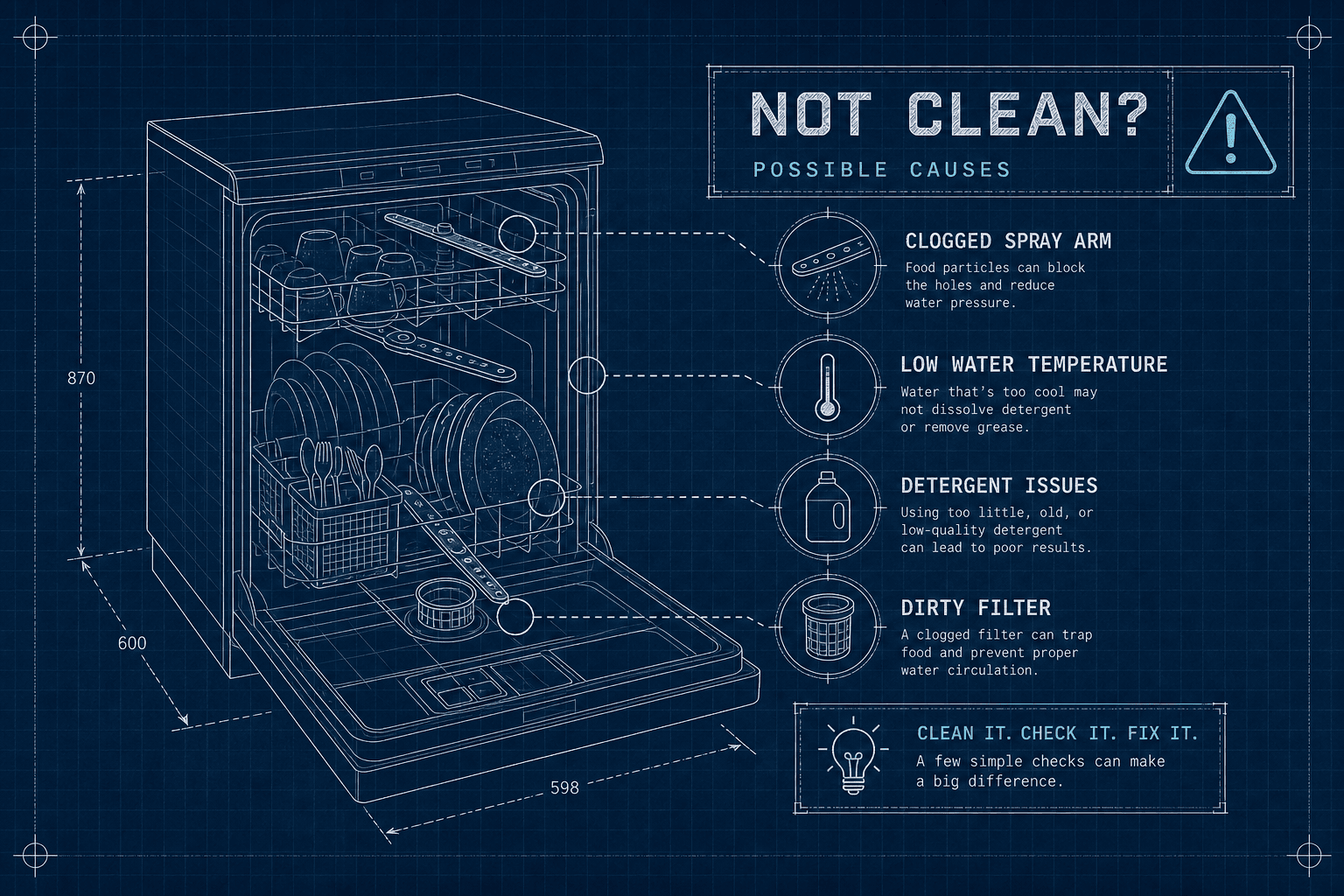
Why is my dishwasher not cleaning dishes properly? Learn the most common causes, from clogged spray arms to incorrect loading, and discover simple fixes to improve cleaning performance.
You run a full cycle, open the door expecting clean dishes, and find food still crusted onto plates and a cloudy film smeared across every glass. If you're asking why your dishwasher is not cleaning dishes properly, you're not alone, it's one of the most frequent calls the engineers at Alpha Appliances Ltd receive, and the good news is that most causes are straightforward to identify once you know what to look for.
This guide covers the four main culprits behind poor dishwasher performance: blocked spray arms, a clogged filter, poor loading habits, and in more stubborn cases, a failing wash pump. Work through each section in order and you'll either fix the problem yourself, or arrive at a confident diagnosis before calling in a certified engineer.
Blocked spray arms and a dirty filter are responsible for the majority of dishwasher cleaning problems, and they're almost always the right place to start. The filter sits at the base of the dishwasher and traps food particles during each cycle. When it's never cleaned, it restricts water flow and causes dirty water to recirculate back onto your dishes rather than draining away. The spray arms distribute pressurised water across both racks; mineral deposits and food debris gradually block the small nozzle holes, reducing coverage and cutting water pressure.
Start by pulling out the lower rack completely. Note that filter removal varies by model, so check your manufacturer's manual before starting, on many machines, you twist the cylindrical filter anti-clockwise and lift the entire assembly out of the base. Rinse it under warm running water, using a soft brush to scrub away any compacted debris.
For households running four to seven loads per week, most manufacturer guidance recommends cleaning the filter monthly. If you rarely scrape plates before loading, you may need to clean it more frequently, every two to three weeks is a sensible interval, though your manual may specify otherwise.
A neglected filter doesn't just cause dirty dishes. Over time, trapped food debris causes odours and puts unnecessary strain on the pump motor. Regular cleaning is the single most effective maintenance habit you can build.
Remove both the upper and lower spray arms. On most machines, the lower arm lifts straight out while the upper arm unscrews with a quarter-turn counterclockwise, but removal methods do vary, check your user manual if you're unsure. Take a toothpick and work through every nozzle hole individually to clear food debris. For limescale buildup, soak the arms in a 50/50 white vinegar and water solution for 30 minutes, then rinse thoroughly before refitting.
Once you reinstall the arms, spin each one by hand to confirm it rotates freely and without wobble. A properly seated arm should spin smoothly with no resistance and a faint, consistent swish as it moves. If an arm catches or wobbles, check the mount first before assuming the arm itself is the problem.
Spray arms occasionally need replacing rather than cleaning. Look for visible cracks along the arm body, nozzle holes that are permanently deformed, or arms that no longer lock securely onto their mounts. A cracked arm can't maintain pressure regardless of how clean it is. Replacement parts are commonly available from OEM and third-party suppliers; costs vary by brand and model.
Incorrect loading is one of the most overlooked causes of poor dishwasher performance, and it's entirely free to fix. When dishes are nested or stacked flat, water hits the outer surface and never reaches what's behind it. Large items placed across the bottom rack block the spray arm from rotating at all, meaning an entire rack gets little to no water coverage during the cycle.
Overlapping bowls create a sealed pocket where water can't penetrate. Glasses placed right-side up collect water rather than shedding it. Cutting boards laid flat across the bottom rack act like a physical shield, stopping the lower spray arm mid-rotation. Each of these mistakes has the same result: water sprays onto one surface and the rest of the load stays dirty.
Angle bowls and plates so the soiled surfaces face toward the nearest spray arm, the key principle is to avoid blocking spray-arm rotation and to ensure water can reach every surface. Place large items like pots and baking trays along the sides and rear of the bottom rack, never flat across the middle. Keep the detergent dispenser door completely clear so it can swing open at the right point in the cycle. Alternate tall and short items along the top rack so water flows between them rather than being blocked by a wall of identical glasses.
Before closing the door, reach in and spin both spray arms manually. If either arm catches on something, rearrange the load until both rotate freely. This 10-second check prevents an entire wasted cycle.
Hard water areas add another layer to this problem. Limescale interferes with detergent effectiveness and restricts spray arm flow at the same time, and if you're in London, Surrey, Hampshire or Berkshire, this is a particularly common factor. For more on how mineral-rich water affects dishwashers, see local hard water guidance.
Run the kitchen tap for 30 to 60 seconds, fill a glass with the hot water, and check the temperature with a thermometer. A reading below 120°F means your water heater is set too low. Most manufacturer guidance recommends a minimum of 120°F (49°C); settings above 130°F increase scald risk and may not comply with local safety regulations, so check your cylinder's guidelines before adjusting. As a practical habit, run the kitchen tap hot for a minute before starting every dishwasher cycle so the machine fills immediately with already-hot water rather than lukewarm pipe water.
Use tabs or pods rather than loose powder for consistent dosing. Powder can clump in the dispenser if humidity is high, and it's easy to use too little without realising. Rinse aid is not optional in hard water areas: it breaks the surface tension of water on glassware so droplets run off cleanly rather than leaving behind spots and a chalky film. If your dishwasher has a salt compartment, keep it topped up with dedicated dishwasher salt to protect the built-in water softener.
For descaling, run an empty hot cycle with a purpose-made descaler tablet monthly. Citric acid-based products such as Affresh, Lemi Shine, and Care+Protect are all widely available in the UK and effective at dissolving calcium deposits from heating elements and internal components. White vinegar works as a budget alternative: pour two cups into the base of an empty machine and run a full hot cycle. Many parts of the South East of England, including London, Surrey, Hampshire and Berkshire, sit in recognised hard-water zones; if you're in one of these areas, check your local water supplier's hardness data and consider making monthly descaling a fixed part of your routine rather than an occasional fix. For more detail on how hard water affects dishwasher performance, see this overview.
If you've cleaned the filter, cleared the spray arms, corrected your loading, and confirmed the water is hot enough, but your dishwasher is still not cleaning dishes properly, the fault is most likely mechanical. This is where the problem moves beyond a scrub and a vinegar soak. The wash pump is the most common internal culprit: it drives water through the spray arms at pressure, and when it begins to fail, cleaning performance drops noticeably across the whole machine.
Dishes consistently coming out dirty on one rack despite correct loading is a reliable indicator of reduced pressure. A noticeable drop in the sound of water spraying during a cycle, or unusual humming and grinding sounds during the wash phase, points specifically to pump wear or a partial blockage in the circulation system. If you hear grinding but the filter is clear, the impeller inside the pump is the likely cause.
A faulty soap dispenser that fails to release detergent at the correct point in the cycle will leave dishes with detergent residue in some areas and no cleaning action in others. Check the dispenser door and spring mechanism for visible damage or warping. A worn door gasket can allow pressure to drop during the wash cycle, reducing cleaning performance across the board. Both components can be inspected by a homeowner, but replacement requires the right parts and is best handled by a trained engineer to avoid causing further damage.
You've worked through the full checklist and the machine is still underperforming. At this point, continuing to guess risks missing a developing mechanical fault that will become progressively more expensive to resolve. Persistent cleaning issues after basic maintenance almost always signal internal component wear that needs proper diagnostic tools and a hands-on inspection to identify accurately.
This is exactly the situation the engineers at Alpha Appliances Ltd are set up for. The team is City and Guilds certified and manufacturer-trained across all major dishwasher brands, and engineers carry genuine replacement parts on every visit. Alpha Appliances offers same-week availability across London, Berkshire, Surrey, Hampshire and Dorset, with fixed-price repairs and no hidden call-out fees, so you get a clear diagnosis and a confirmed repair cost before any work begins. We also cover local areas including Chessington and Brondesbury.
A certified engineer will test water pressure at the inlet, inspect the pump and motor for wear, check the heating element, and run the machine through diagnostic cycles using the manufacturer's software. These checks can't be done safely or accurately without specialist tools and training. A professional visit doesn't just fix the immediate symptom: it gives you a documented service report and confirmation that the repair has been done to the manufacturer's standard, which matters particularly for warranty compliance and landlord obligations.
Most dishwasher cleaning problems are entirely preventable with a consistent monthly routine. The maintenance habits that matter most take well under an hour combined and will extend the machine's working life significantly compared to running it without any upkeep.
Each month, work through these four tasks:
Done consistently, these steps prevent the vast majority of the cleaning problems covered in this guide.
Run the kitchen hot tap for at least 30 seconds before starting a cycle so the dishwasher fills with already-hot water from the first minute. Check the salt and rinse aid indicators on the door and top them up before they run empty rather than after. Scrape large food debris off plates before loading, but don't pre-rinse: modern dishwasher detergent needs some soil to work against, and pre-rinsing can actually reduce cleaning performance with enzyme-based tablets.
Work through the diagnostic path in order. Start with the filter and spray arms, which resolve the majority of cases. Check your loading habits next, then confirm your water temperature and detergent setup. If the problem persists after all of those steps, the cause is mechanical and needs a professional diagnosis. Many dishwasher cleaning issues are fixable at home, often in under an hour, with the right information and a methodical approach.
When the DIY route doesn't resolve it, or when you'd rather have a certified engineer confirm the diagnosis correctly the first time, booking a visit with Alpha Appliances Ltd is the practical next move. Their online booking system takes minutes, appointments are available same-week across the South of England, and every repair comes with a fixed price agreed upfront. If your dishwasher is not cleaning dishes properly after working through this guide, that's the call worth making.
Book a visit from a certified Alpha engineer in minutes.
TRUSTED BY HOMEOWNERS
Fast, reliable, and warranty-backed repairs for every major brand.
Discover more tips from Alpha engineers.