
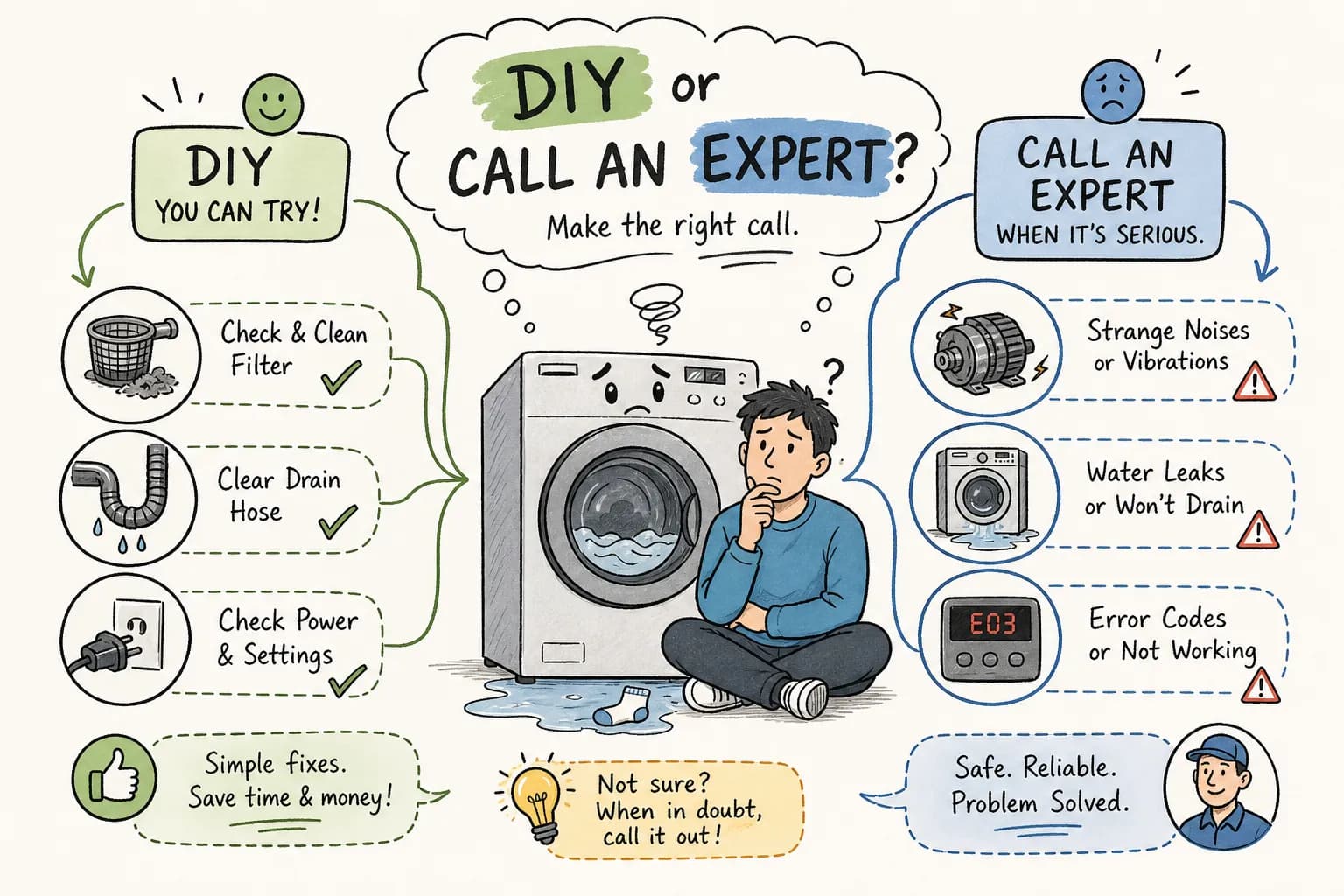
When to DIY and When to Call a Washing Machine Engineer
You're halfway through a wash cycle when the machine stops dead. Water sits cold in the drum, an error code blinks on the display, and you're already opening YouTube on your phone. The call-out fee feels steep, but so does the idea of flooding your utility room on a Sunday afternoon. Many UK homeowners face exactly this dilemma, and the honest answer isn't always obvious. So: how do you know if your washing machine fault needs a professional engineer or a DIY fix? That's precisely what this guide is here to answer.
Over many years and thousands of repairs across London and the Home Counties, the engineers at Alpha Appliances Ltd have encountered every symptom imaginable, from a five-pence coin jammed in a pump filter to a completely seized motor on a three-year-old Bosch. In our experience, the single biggest mistake people make isn't attempting a repair they can't complete. It's misreading which category their fault belongs to in the first place. Some faults are genuinely straightforward; others look innocent but carry a real safety risk.
This guide gives you an honest breakdown. You'll learn which faults are safe to investigate yourself, which symptoms mean you stop and call a professional, how to read error codes, what repairs actually cost in 2026, and how to protect your warranty throughout.
The Washing Machine Faults You Can Safely Sort Yourself
A significant number of common washing machine problems don't require an engineer at all. Knowing what you can safely handle is just as useful as knowing what to leave alone, and it saves both money and anxiety. The key is approaching the inspection methodically rather than diving straight in.
Safety First: How to Isolate the Appliance Before Touching Anything
Before you open a single panel or peer behind the machine, the appliance must be fully isolated. Switch it off at the wall socket, pull the plug out completely, and close the isolation valve on the cold water inlet hose by turning it clockwise until it stops. These two steps remove the main hazards in any appliance inspection: live electrical circuits and residual water pressure. Neither is negotiable, regardless of how simple the fault looks.
DIY-Friendly Fixes: Filter Cleaning, Hose Checks and Levelling
The drain pump filter is the most commonly overlooked component in any washing machine, and a blocked one accounts for a surprising number of drainage faults, error codes and even mid-cycle stops. It sits behind a small access panel on the lower front of most machines. Place a towel and a shallow bucket underneath before you open it, because water will spill out. Unscrew the filter cap, pull out whatever has accumulated, coins, hair grips, lint and the occasional sock are all typical finds, rinse the filter under a tap, and refit it. A screwdriver, pliers and a torch are all you need.
Hose connections are worth checking next. Inspect both the cold water inlet hose at the rear and the drain hose where it meets the standpipe. Look for kinks, splits or connections that have worked loose over time. A kinked drain hose is a common cause of drainage errors that display as fault codes, and straightening it costs nothing. While you're at the back of the machine, check that all four feet are in firm contact with the floor. An unlevel machine will bang and vibrate during spin, which over time can worsen bearing wear. Adjust the feet until the machine sits flat, then tighten the lock nuts.
The rubber door seal deserves regular attention too. Mould and debris accumulate in the folds of the gasket, causing odours, poor door closure and eventually seal deterioration. Wipe it down with a damp cloth, paying particular attention to the underside of the fold where water pools after each cycle. Doing this regularly helps prevent a fault that would otherwise require a seal replacement, though note that even a well-maintained seal will eventually wear and need replacing in time.
How Do I Know If My Washing Machine Fault Needs a Professional? Key Warning Signs
Some symptoms are not ambiguous. They point to a live safety risk or internal mechanical failure that requires specialist knowledge and tools, not confidence gained from a tutorial video. Knowing how to recognise these symptoms clearly is the most important skill in washing machine fault diagnosis, and it's where the DIY versus professional question becomes non-negotiable.
Burning Smell and a Tripping RCD: Treat These as Emergencies
A burning smell from a washing machine signals an overheating motor, shorted wiring, or water that has reached live electrical components. None of these are conditions you can assess safely yourself. A tripping RCD, the safety switch on your consumer unit that cuts power when current leaks to earth, is a definitive sign of an electrical fault inside the appliance. In both cases, disconnect the machine immediately by pulling the plug and do not attempt to use it again until a qualified engineer has inspected it. These faults do not become less serious after a reset.
A leak accompanied by an error code or a burning smell is equally serious. It suggests water has reached live components, creating a short-circuit risk. Turn off the isolation valve, unplug the machine, and call an engineer the same day.
Loud Grinding, No Spin and Persistent Internal Leaks
A loud rumbling or grinding noise during the spin cycle almost always indicates worn drum bearings. This fault is progressive: left untreated, it leads to drum instability and eventually catastrophic failure of the rear drum assembly. Replacing drum bearings requires full disassembly of the machine, access to the inner and outer drum halves, and in many cases a bearing press to remove and refit the bearing correctly. It is not a job that can be done with general household tools.
A washing machine that fills but won't spin, where the drum stays completely stationary, typically points to a broken drive belt, a failed motor, or a faulty capacitor. These components sit inside the machine and require the rear or front panel to be removed and the drum assembly to be accessed. Leaks originating from inside the machine, as opposed to from visible hose connections, suggest a damaged pump housing, a split internal hose, or a breach in the bearing seal. All three require professional assessment. If you can't trace the source of water to a visible external connection, call an engineer.
Making Sense of Your Machine's Error Codes
Most modern washing machines display an error code before they fail completely. This is the machine telling you exactly where the problem lies, and understanding what these codes mean is the fastest way to work out whether you're dealing with a blockage or a failed component.
Codes You Can Usually Act on Yourself
Drainage error codes are the most common user-resolvable faults across all major brands. The following all point to the same probable cause, a blocked pump filter or a kinked drain hose: Bosch E18 or F18, Hotpoint F05, Samsung 5E or OE, and Beko E02. Clear the filter, straighten the hose, and run a short cycle. On Samsung machines, the 4E or IE code indicates a water supply problem, most often caused by a closed tap or a blocked inlet mesh filter at the back of the machine where the hose connects. These take minutes to check. Door lock codes, such as Bosch E01, Samsung dE, Hotpoint F06 and Beko E06, often appear simply because the door hasn't closed properly or because debris is caught in the door seal preventing a full seal. Check the door and the seal before assuming the interlock has failed.
Codes That Always Require a Qualified Engineer
Control board and PCB faults are beyond user intervention. Hotpoint F01, F12 and F18, Bosch F09 and E12, and Beko E02 in the context of a relay fault all indicate electronic failure that requires diagnostic equipment and professional component replacement. Attempting to reset these repeatedly without professional diagnosis can cause further damage to the board.
Motor circuit errors, including Hotpoint F02, Bosch F21 and E06, and Samsung 3E and LE, require professional assessment of the motor, its wiring and any associated capacitors. Heating element faults (Hotpoint F07 and F08, Beko E09, Samsung tE or HE) involve high-voltage components that must only be handled by a qualified engineer. Anti-flood codes such as Bosch AquaStop activation or Beko E01 and E15 mean water has been detected in the base pan of the machine, indicating a serious internal leak. If a user-serviceable fix doesn't clear the code after one attempt, escalating to a professional is always the right decision.
What a Washing Machine Repair Actually Costs in the UK
One of the most common reasons people attempt repairs they shouldn't is anxiety about open-ended costs. The reality in 2026 is more predictable than most people assume, and understanding the actual figures makes the appliance repair vs DIY decision considerably easier.
Typical Call-Out Fees, Labour Rates and Parts Costs in 2026
Based on current market rates, call-out fees across the UK range from approximately £50 to £120, with engineers in London typically towards the upper end of that range. Labour runs at around £45 to £90 per hour for independent engineers, and higher for manufacturer-authorised specialists. Most single-fault repairs take between one and two hours to complete. Estimated all-in repair costs (call-out, labour and parts combined) break down roughly as follows:
- Door seal replacement: £78 to £120
- Drain pump replacement: £80 to £160
- Drum bearings: £150 to £280
- Motor replacement: £220 to £400
- PCB or control board: £150 to £250
For machines under eight years old, most single-component repairs represent good value against the cost of a replacement appliance. For major repairs on older machines, that calculation shifts, and a good engineer will tell you honestly if the repair isn't economical.
Why Fixed-Price Repairs Make the Decision Easier Than You'd Expect
The biggest shift for homeowners who call a professional is realising the cost is more predictable than they feared. At Alpha Appliances Ltd, the fixed-price repair model means the diagnosis, labour and parts are agreed upfront before any work begins, with no hidden extras added at the end of the visit. That transparency removes the guesswork that makes people reluctant to pick up the phone, and it means you can make a genuinely informed decision about whether the repair is worth proceeding with before any money changes hands.
Will a DIY Repair Void Your Washing Machine Warranty?
This is a practical deterrent that many people overlook until it's too late, and it changes the calculation significantly if your machine is less than two years old or you own a premium brand appliance.
What Actually Voids Manufacturer Cover
For domestic appliances, the situation is stricter than it is for cars. Most appliance manufacturers require repairs to be carried out by an authorised service provider to maintain warranty cover. Using an unqualified engineer, fitting non-genuine parts, or opening and attempting to repair the machine yourself can void the entire warranty, not just cover for the specific fault you worked on. If your Bosch, Miele or Samsung machine is within its warranty period and you open the outer casing or access internal components, you may be forfeiting the remaining cover on the whole appliance.
The Consumer Rights Act 2015 provides a separate layer of statutory protection, giving you rights against the retailer for up to six years in England and Wales for goods that develop an inherent fault. This statutory cover cannot be removed by warranty terms. However, if a manufacturer can demonstrate that your DIY intervention directly caused the fault you're claiming for, your warranty claim for that specific fault can legitimately be refused.
When an Authorised Engineer Is Non-Negotiable
There are scenarios where the choice is straightforward: if the machine is within its manufacturer warranty period, if the fault involves a safety system such as AquaStop or an anti-flood sensor, or if the repair requires a software reset or control board reprogramming, an authorised engineer is the only option that preserves your cover. Cleaning the drain pump filter sits outside this concern; it is generally considered routine maintenance and, in most cases, does not compromise warranty terms, though it's worth checking your specific manufacturer's guidance to be certain. Any repair that requires opening panels, accessing internal components, or handling electrical parts sits in a different category entirely.
How to Find a Washing Machine Engineer You Can Actually Trust
Once you've decided the fault needs a professional, choosing the right engineer is the final step. The market includes everything from properly certified specialists to generalist handymen working without formal qualifications, and the difference between the two matters significantly for the quality and longevity of the repair.
Qualifications and Credentials Worth Checking Before You Book
A competent washing machine engineer in the UK should hold City & Guilds qualifications in domestic appliance repair. Safe Contractor approval is a further marker of a properly vetted business that has passed independent health, safety and compliance checks. For premium brands such as Miele, Bosch or AEG, manufacturer-trained technicians are worth seeking out specifically. Component knowledge on high-end appliances directly affects both the quality of the repair and the first-time fix rate, a generalist working on a Miele drum assembly for the first time is a very different proposition to a specialist who works on that machine regularly.
Questions to Ask Before Confirming Any Booking
Before you commit, ask these questions directly. Does the engineer provide a written quote before starting work? Is the price fixed or subject to change once the machine is opened? Do they use genuine replacement parts? Will they provide a service report after the repair? A service report matters for landlords who need documentation for tenant compliance, and for anyone whose appliance is covered under a home insurance policy or extended warranty scheme.
A reputable engineer answers all of these questions without hesitation and confirms the details in writing before visiting. If any response is vague or the engineer is reluctant to commit to a fixed price, look elsewhere. The engineers at Alpha Appliances Ltd operate on exactly this basis: transparent quotes, fixed pricing, genuine parts and a written service report provided as standard on every job.
How Do I Know If My Washing Machine Fault Needs a Professional Engineer or a DIY Fix? The Short Answer
The choice between DIY and a professional repair is not primarily about saving money. It's about correctly identifying what you're dealing with. Filter cleaning, hose checks, levelling and door seal maintenance belong squarely in the homeowner's domain and require nothing beyond basic tools and a spare ten minutes. Anything involving the motor, drum bearings, heating element, PCB or live electrical components is firmly the engineer's territory, regardless of how confident you feel or how many views the tutorial has.
The symptoms covered in this guide give you the framework to make that call accurately. If you've worked through the basics and the fault persists, or if you recognise any of the engineer-only warning signs, trust that assessment. Requesting a fixed-price quote from a certified engineer is straightforward and costs nothing upfront. Acting on an electrical fault with the wrong approach, on the other hand, can cost considerably more than the original repair, and in rare cases the consequences go well beyond the appliance itself.
If you want to take the next step, Alpha Appliances Ltd serves London, Berkshire, Surrey, Hampshire and Dorset, offering honest diagnostics, next-day availability and a strong first-time fix rate across all major brands. If you're still asking yourself how do I know if my washing machine fault needs a professional engineer or a DIY fix, book a diagnostic with us online, the quote is confirmed before an engineer sets foot in your home.
Need a repair today?
Book a visit from a certified Alpha engineer in minutes.