
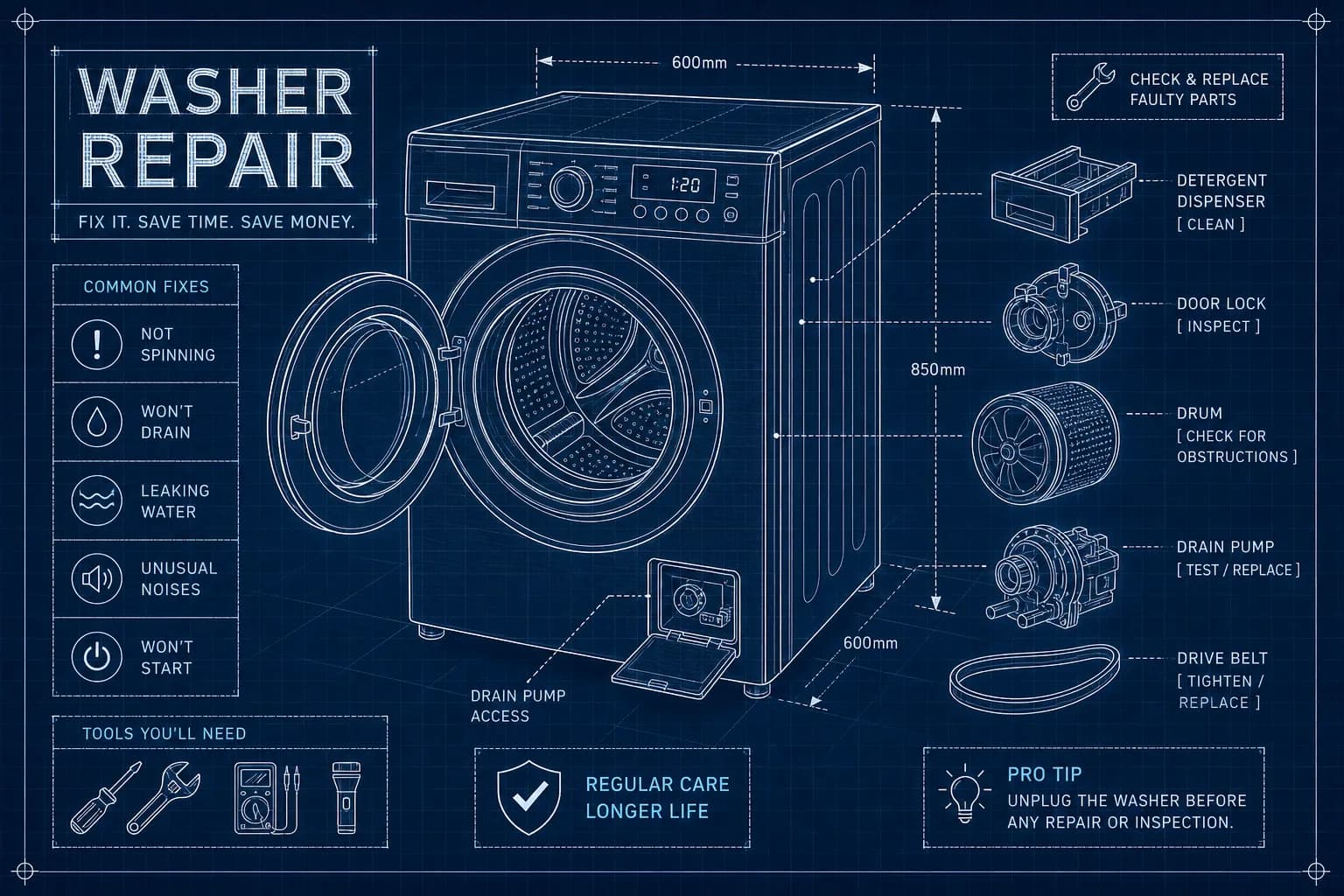
The Complete Guide to Laundry Washer Repair
A broken washing machine is one of those household faults that simply can't wait. Within a day, the laundry piles up, the disruption starts, and if you've got children or a busy household, the pressure mounts fast. This guide walks you through the most common faults, what you can safely check yourself, what washing machine repair realistically costs in 2026, and how to decide whether fixing or replacing makes more financial sense. By the end, you'll know exactly what to do next. You won't waste money on a needless call-out, nor risk making things worse with an ill-judged DIY attempt.
The most common washing machine faults and what they're telling you
Most washing machine problems fall into a handful of categories, and understanding what each symptom actually means saves you time and money before you pick up the phone. The single most important thing to know: many faults are secondary symptoms. A machine that won't spin, for example, has usually failed to drain first. Chase the root cause, not the surface symptom.
Drum not spinning
Spin failure is one of the most frequently reported faults, and the majority of cases trace back to a drainage problem rather than a mechanical one. If water remains in the drum, the machine won't spin as a safety measure. Beyond drainage, the other common causes are an unbalanced load triggering a safety stop, a faulty door latch preventing the cycle from completing, or a mechanical fault with the belt or motor. Always check drainage first before assuming the worst.
Water not draining
A blocked pump filter is the single most common cause of drainage failure across all washing machine brands, and it's also the most straightforward to resolve yourself. After that, a kinked or blocked drain hose and a failed drain pump are the next likely culprits. Most modern machines display error codes when drainage is obstructed: codes in the E18/F18 family on Bosch, 5E or SE on Samsung, and F05 or F11 on Hotpoint all point to drainage faults. These codes narrow the diagnosis quickly, though they tell you the symptom rather than always identifying the root cause.
Leaks, noise, and faults that are easy to misread
Leaks typically originate from the door seal, hose connections, or a poorly refitted filter cap. Excessive vibration during spin is almost always a user fix: redistribute the load, reduce the load size, or adjust the levelling feet. The critical distinction is between vibration caused by an unbalanced load and a steady grinding or rumbling noise that deepens over time. The former is a non-issue; the latter points to worn drum bearings, which is a specialist repair requiring proper dismantling and reassembly.
Safe DIY washing machine repair checks to run before calling anyone out
A surprising proportion of washing machine call-outs are resolved by checks that cost nothing and take less than ten minutes. Running through these first is always worthwhile.
Start with the non-invasive basics before reaching for the phone:
- Power-cycle the machine by unplugging it for 60 seconds and restarting
- Confirm the door is closing fully and latching properly
- Check that the cold water tap behind the machine is fully open
- Redistribute a lopsided load evenly around the drum
- Verify the machine is level on the floor, adjust the feet if not
These steps alone resolve a meaningful number of fault calls.
How to clean the pump filter
This single check resolves the majority of drainage and spin faults, and it's well within reach for any homeowner. Unplug the machine first. The filter access panel is usually at the front bottom of the machine, behind a small flap or kick plate. Lay towels and a shallow tray on the floor to catch spillage, then unscrew the filter cap slowly so water trickles out in a controlled way rather than flooding out at once. Remove the filter, clear any lint, hair, or debris, rinse it under the tap, and refit it securely by turning it clockwise until firmly seated. Run a short drain cycle to confirm the fix.
If the filter is clear and the fault persists, the problem moves from DIY territory into engineer territory. At that point, continuing to investigate without proper tools and training risks flooding, injury, or voiding any remaining warranty. Hose checks, load balancing, levelling, filter cleaning, and soft resets are the safe boundary for most homeowners. Bearing replacement, motor faults, control board errors, internal wiring, and pump replacement all require proper diagnosis from a qualified engineer.
Faults that need a certified washing machine engineer
Some repairs are technically complex, some carry genuine safety risks, and some are both. Drum bearings, for example, often require the entire front panel to come off before the work can even begin. A bearing replacement in the UK costs around £150 to £320 all-in depending on the machine and its complexity, with sealed-tub designs sitting at the higher end. Motor failure, worn carbon brushes, belt replacement, PCB and control board faults, and faulty heating elements all fall into the same category: jobs where getting the diagnosis wrong can turn a £120 repair into a £400 one.
This is where manufacturer training and formal accreditation make a real difference. A City and Guilds certified engineer with brand-specific training knows the tolerances, part numbers, and failure patterns for the machine in front of them. At Alpha Appliances Ltd, our manufacturer-trained engineers carry a 78% first-time fix rate across all appliance brands, meaning the vast majority of jobs are resolved in a single visit. When your household is running without a working washing machine, that's not a minor detail.
Error codes are useful clues but not a full diagnosis. They narrow the field considerably, but the same code can have multiple underlying causes. A drainage code, for example, might mean a blocked filter, a kinked hose, or a failed pump. Knowing which one requires a proper assessment, not just a code lookup.
Washing machine repair costs in 2026
Understanding the typical cost structure before you book removes the risk of being caught off-guard when the invoice arrives. Call-out and diagnostic fees across the UK typically run from £60 to £100, with labour charged at £50 to £100 per hour on top. Most straightforward jobs take one to two hours. Parts for common faults, such as a pump, door seal, or carbon brushes, add around £20 to £60. A realistic total for a standard repair lands between £125 and £200, while complex jobs involving control boards, bearings, or motors can reach £250 to £400 or more.
Regional pricing variation is real and worth factoring in. In London and the South East, call-out fees alone often sit between £80 and £110, and the total bill for the same fault can run £50 to £100 higher than the national average. If you're searching for washing machine repair in London or a washer repair near you, fixed-price services remove this ambiguity: you know what you're paying before the engineer arrives, with no extras added after the fact.
There are also hidden costs worth anticipating. A second call-out because a part wasn't carried on the first visit, additional labour for accessing components on compact or integrated machines, and out-of-hours surcharges can all inflate a bill unexpectedly. Choosing a service with a high first-time fix rate and a well-stocked van significantly reduces these risks.
Repair or replace: making the right call
A practical benchmark many engineers use is the 50% rule: if the repair estimate reaches half the cost of a comparable new machine, replacement is usually the more economical choice. For machines over eight to ten years old, tighten that threshold to 30 to 40%, because an ageing washer that fails once will often fail again on a different component within 12 to 18 months.
To put this in concrete terms, here's where new UK machine pricing currently sits in 2026:
- Entry-level: approximately £200 to £350
- Mid-range: approximately £350 to £650
- Premium or large-capacity: approximately £650 to £1,200 and above
A £180 repair bill on a five-year-old mid-range machine is clearly worth doing. The same bill on an eleven-year-old entry-level washer is a different conversation, particularly if genuine parts are becoming harder to source for that model.
Energy efficiency is a genuine factor too, not just a selling point. Machines manufactured before 2015 typically carry significantly higher annual running costs than modern A-rated equivalents. Factor in whether the machine is under any remaining warranty or appliance insurance, and whether a repair now buys meaningful additional lifespan or simply delays the inevitable by a few months.
How to find a trustworthy appliance repair service near you
Use vetted trade directories as your starting point. TrustATrader and Checkatrade both pre-screen engineers for qualifications and insurance before listing them, which removes the guesswork from initial vetting. Look for City and Guilds certification, Safe Contractor approval, and Gas Safe registration where the work involves gas appliances. Customer reviews are useful, but focus on patterns across multiple reviews rather than individual ratings, and pay attention to whether the company responded professionally to any negative feedback.
Before you book, ask the right questions. Confirm whether the diagnostic fee is deducted from the repair cost if you proceed. Ask whether parts used are genuine manufacturer-approved components. Find out the first-time fix rate and whether the engineer carries common parts for your machine's brand on the van. Request a written quote before any work begins. Any reputable washing machine repair service should answer all of these without hesitation.
On availability: in major UK cities, same-day and next-day slots are genuinely available from established repair services, particularly if you book before midday. For London, the South East, and other urban centres, same-day emergency visits are widely offered. Availability narrows in rural areas, but next-day booking from a service with high first-time fix rates is almost always preferable to waiting a week for a manufacturer-authorised centre slot.
What to do right now
The pattern across most washing machine faults is consistent: check the simple things first, filter, hoses, load balance, door latch, reset if appropriate, and if the problem persists, call a certified engineer rather than risk making it worse. Knowing the realistic cost structure in advance means you can book with confidence and assess whether repair or replacement makes financial sense before anyone arrives at your door.
For anything beyond basic DIY checks, you want a washing machine repair service that offers transparent pricing, genuine parts, and engineers who get it right first time. At Alpha Appliances Ltd, we cover London, Berkshire, Surrey, Hampshire, and Dorset with City and Guilds certified engineers, next-day availability, and no hidden fees. Book a diagnostic visit today, our engineers will give you a straight answer before any work begins.
Need a repair today?
Book a visit from a certified Alpha engineer in minutes.