
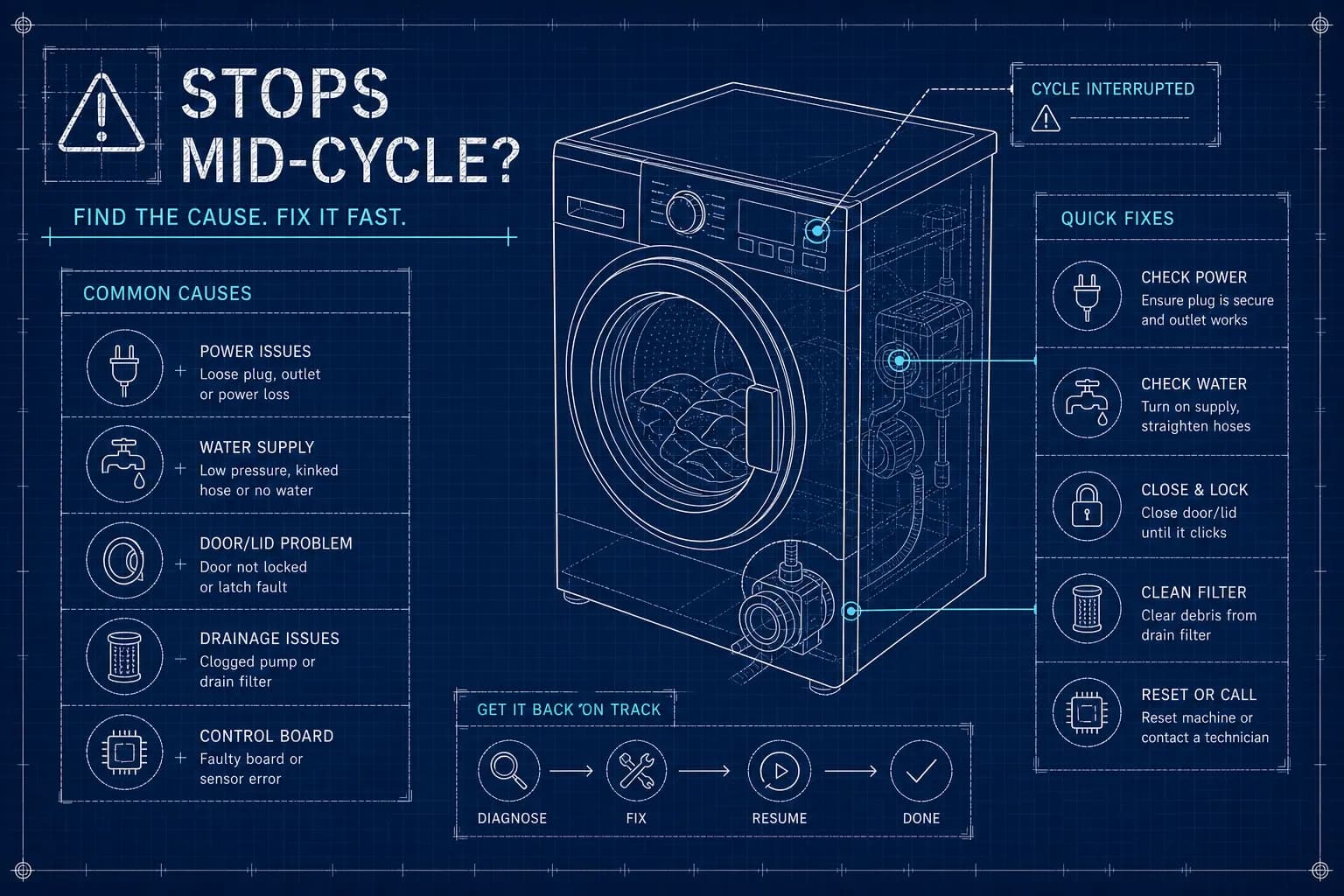
Washing Machine Stopping Mid-Cycle: Common Causes and Fixes
If you've ever wondered what are the most common reasons a washing machine stops working mid-cycle, you're not alone, it's one of the most frequent call-outs the team at Alpha Appliances Ltd handles week in, week out. You put a load on before work, come back at lunchtime, and find the drum full of soaking wet clothes with the cycle frozen at 38 minutes. No warning, no explanation, just silence. This article walks you through the most likely causes, what fault codes actually mean, the safe checks you can run yourself, and when it's time to hand the problem to a qualified engineer.
What are the most common reasons a washing machine stops working mid-cycle?
When a washer cuts out during a cycle, the fault almost always falls into one of a handful of categories. Get familiar with them and you'll narrow down the problem quickly, rather than spending an afternoon guessing.
Door lock and interlock failures
The door lock is a safety circuit. If the machine loses confidence that the door is properly secured, it will normally stop the cycle as a safety measure, sometimes a fault code or lock indicator appears, sometimes it does not. There are two ways this plays out. Either the latch doesn't engage fully when you start the cycle, or the interlock loses its signal partway through a wash. In both cases the machine often goes quiet without displaying a fault code, which makes this cause particularly easy to overlook.
Drainage blockages and pump faults
A washing machine cannot advance to the rinse or spin stage if it cannot drain. The most common culprits are lint, hair, coins, and small buttons lodged in the pump filter, or a drain hose that has kinked. When this happens the machine sits with a drum full of water and refuses to move forward, a classic sign that the washer won't finish the cycle. That tell-tale combination of standing water plus a cycle that won't progress almost always points straight to the drain system. Indeed, when a washing machine drains then stops before completing a spin, a partially blocked filter is frequently the cause.
Overheating motors and power supply interruptions
Every washing machine motor has a built-in thermal cutout that activates when the motor runs too hot. This is more common in older machines running long, high-temperature cycles back-to-back. The fix is simply letting the machine cool for 30 to 60 minutes before restarting. Power interruptions are a separate but related cause: a tripped circuit breaker or a brief voltage dip can reset the machine mid-cycle, leaving it stranded at whatever stage it reached when the power dropped. In this scenario the washer stops during spin or mid-wash without any internal fault actually being present.
What your machine's fault codes are telling you
A fault code is the machine's way of pointing you at a specific problem. Most codes are far more useful than people realise, provided you know what you're looking at.
Common washing machine fault codes for drainage and door faults
For drainage issues, the codes you'll encounter most often in UK homes are Hotpoint F05, Beko E18, and the generic codes E3, F21, and 5E. They all mean the same thing: the machine couldn't drain within the allotted time. For door lock failures, look for Hotpoint F06, IFB DOR, Bosch E16 or F16, and the generic "dL" or "Lid" indication. These are single-component signals. Each one typically points to one identifiable fault with a clear fix, and they generally won't return once you've correctly addressed the underlying cause, although persistent or intermittent codes can recur if the root cause isn't fully resolved.
Codes that point to something more serious
Codes in the E92 to E97 range, along with EB2 (voltage too low), are a different matter. These indicate communication failures between the main PCB and the display board, incorrect configuration errors, or EEPROM faults. The giveaway with these codes is that these codes reappear almost immediately after a power reset, because the issue lies in the control board itself rather than in a mechanical component you can clean or replace cheaply. The PF code (power failure) is worth knowing separately: it simply means the cycle was interrupted by a voltage drop, not by an internal fault. One power reset is usually enough to clear it.
Always cross-reference any code against your specific model's user manual before attempting a fix. Bosch codes, for example, appear as both E18 and F18 depending on the model series, but they describe the same drainage fault.
Safe checks to run before calling anyone
These steps are safe, require no specialist tools, and resolve a significant proportion of mid-cycle stops without any further intervention. Work through them in order.
Start with a power reset and load check
Unplug the machine and leave it for at least one minute. On Bosch models and several other European brands, a full 20-minute wait allows the system to reset completely. While the machine is off, open the door, remove some of the load if it feels heavy, and redistribute the remaining clothes so they sit evenly in the drum. An unbalanced or overloaded drum is one of the most overlooked reasons a washing machine stops working mid-cycle. Once you plug back in, select a Drain and Spin cycle first to clear any standing water before attempting a full wash.
Cleaning the drain pump filter: step by step
Always unplug the machine before you start, this is a straightforward job that takes around 10 minutes.
- Locate the service flap, usually at the bottom-front of the machine.
- Place a towel and a shallow bucket directly underneath before opening it.
- Slowly unscrew the filter anticlockwise and let the water drain into the bucket in stages, pausing to empty the bucket as needed.
- Remove all debris: lint, hair, coins, and buttons are the usual offenders.
- Check that the pump impeller spins freely with your finger, then refit the filter securely and turn it clockwise until it's hand-tight.
Checking the door latch
Inspect the latch for visible damage, misalignment, or any debris stopping it from clicking fully shut. Sometimes a small piece of fabric or a build-up of detergent residue around the seal is enough to prevent a firm close. If the door closes and latches physically but the lock symbol remains on the display and the cycle still stops, the interlock itself has failed. At that point it needs replacing, and that's a job for a qualified engineer.
How to tell if the fault is electrical or mechanical
This distinction matters because it determines whether more DIY checks are worthwhile or whether you're better off stopping and calling for professional help.
Signs that point to a control board problem
Multiple unrelated symptoms appearing at once are the clearest indicator of a board fault. If the machine won't fill, won't drain, and the buttons are unresponsive all at the same time, the board controls all three of those functions and something central has gone wrong. Other red flags include erratic behaviour, the machine draining before it fills, skipping cycle stages, stopping at a different point on every wash, or a display that flickers or goes blank. Error codes that clear briefly after a power reset and then immediately return are a strong indicator that the PCB is involved rather than a mechanical component.
Signs of a single-component mechanical fault
A mechanical fault looks very different. One consistent failure while everything else works normally is the pattern to look for. The water won't drain but the buttons respond normally. The drum won't spin but the machine fills, heats, and displays correctly. Grinding, humming, or buzzing sounds that started at the same time as the fault usually point to the pump or motor rather than the board. A persistent single code such as F05 or E18 that matches the symptom exactly confirms you're dealing with a mechanical cause, and that's generally good news because mechanical repairs cost less and take less time.
What these repairs typically cost in the UK
Knowing the likely cost in advance makes it much easier to decide whether a repair is worth pursuing. The figures below cover parts and labour combined and are approximate, reflecting typical UK market rates, your final quote may vary by region, appliance brand, and parts availability. Most established firms include the call-out fee within these ranges; confirm this when you book.
- Door lock or interlock: £60 to £150 total. Parts typically run £10 to £40 and the job takes around one hour.
- Drain pump replacement: £80 to £160 total. Pump parts cost £20 to £90 and replacement is a straightforward one-hour job.
- PCB or control board: £150 to £400 depending on the model and parts availability. This is the repair where machine age matters most.
- Pressure or temperature sensors: Usually quoted as part of a wider electronic repair, totalling £150 to £290.
A useful rule of thumb: if the repair quote exceeds half the cost of a comparable new machine, or if the machine is over eight to ten years old and the fault is a PCB or motor, replacement tends to be the sounder financial decision. For newer machines or simpler faults such as a door lock or blocked pump, repair almost always makes sense.
When to stop troubleshooting and call a qualified engineer
There's a clear line between what a careful homeowner can safely check and what requires professional training and equipment.
Faults that need a trained engineer, not a video tutorial
If fault codes point to the PCB, motor, or heating element, continuing to self-diagnose risks making the fault worse or voiding any remaining manufacturer warranty. Any work involving the machine's wiring, heating element, or control board should be handled by a qualified appliance engineer. The risk isn't physical access, a misdiagnosis at this level is simply expensive to undo. If the machine is still under warranty, using an uncertified repairer will invalidate it outright.
How Alpha Appliances Ltd approaches mid-cycle failures
Alpha Appliances Ltd specialises in exactly this type of fault: washing machines that have stopped without warning and left a household without laundry. Their manufacturer-trained engineers carry common parts on every van, enabling a strong first-time fix rate across all appliance brands. Book online in four steps or call the team directly for a no-obligation quote.
Rather than leaving you waiting for a manufacturer service slot, Alpha Appliances Ltd offers prompt availability across Greater London, Berkshire, Surrey, Hampshire, and Dorset, with fixed-price diagnostics so you know the cost before any work begins. For service area details and current pricing, visit the Alpha Appliances Ltd website or speak to the team directly.
Getting back to a working machine
The diagnostic pathway is clear: start with the obvious checks first. Redistribute the load, clean the drain filter, inspect the door latch, and run a power reset. Read the fault code if one appears, and use it to distinguish a single mechanical fault from the erratic multi-system behaviour that suggests a board problem. Then weigh the repair cost against the machine's age before committing to a fix.
Most mid-cycle stops have a single, fixable cause. They rarely mean the machine is beyond saving. A blocked filter or a failed door interlock is not a death sentence for an otherwise sound appliance, and catching the fault early almost always keeps the repair cost down.
Still asking what are the most common reasons a washing machine stops working mid-cycle and not finding a clear answer from the basic checks? When the fault code keeps returning and the standard checks have run out, the fastest route to a working machine is a qualified engineer with the right parts on the van. For readers across London and the South of England, Alpha Appliances Ltd is ready to help. Book a repair visit online or call for a fixed-price quote today.
Need a repair today?
Book a visit from a certified Alpha engineer in minutes.