
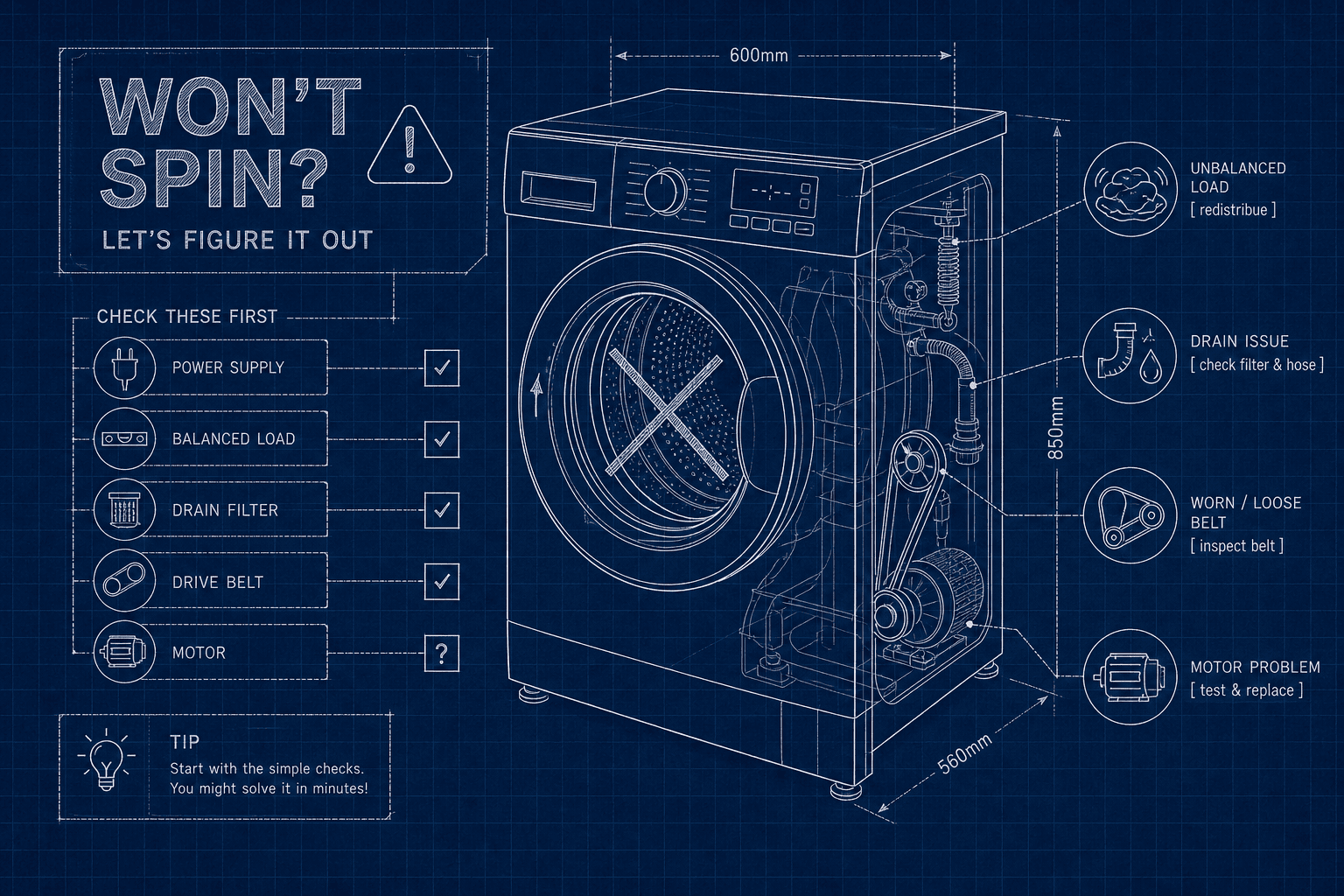
These checks require no tools, no technical knowledge, and no dismantling. The goal is to rule out the most common causes before assuming anything serious is wrong. Safety first: always unplug the machine before you touch the filter, access panel, or hose. A machine with water still in the drum is heavier than it looks, so brace it before moving it away from the wall.
Redistribute the load and check the machine is level
Start here, because this check takes two minutes and fixes a large proportion of spin failures. Pause the cycle using the programme selector or pause button, then open the door and pull the laundry out onto a flat surface. Look for large items that have clumped together or wrapped around each other. Redistribute everything evenly around the drum, remove a few items if the load feels very heavy, and restart.
Once the cycle is running, check for rocking. Place your hands on the top corners and push gently in opposite directions. If the machine rocks, the levelling feet need adjusting. Screw them in or out until the machine sits flat and firm on all four corners. Many machines have lock nuts on each foot, check your owner's manual if the feet look different on your model. Where present: loosen the nut, adjust the foot, then retighten the nut to hold the position.
Clear the drain hose and pump filter step by step
For a washing machine not spinning and full of water, clearing the drain pump and filter is one of the most effective home fixes you can try. The general process below applies to many front-loaders, including Samsung, Whirlpool, Beko, and Maytag, but access points and procedures can vary by model, so consult your owner's manual for model-specific guidance. You can find manufacturer-specific debris-filter instructions for Samsung machines on Samsung's support pages.
- Unplug the machine and pull it forward from the wall slightly.
- Lay towels on the floor in front of the lower access flap and place a shallow tray beneath it.
- Open the access flap and locate the small emergency drain hose. Pull it free, remove the cap, and drain the water into the tray slowly. This step matters: removing the filter under load releases water fast.
- Once the water is drained, unscrew the pump filter counterclockwise. Pull it free and clear lint, coins, hair grips, or any debris from the filter and the housing behind it.
- Check that the impeller (the small plastic propeller inside the housing) turns freely by hand. If it's jammed, clear the obstruction carefully.
- Inspect the drain hose at the back of the machine for kinks, twists, or crushing. Straighten and reconnect securely if needed.
- Refit the filter clockwise until it seats firmly, close the access flap, restore power, and run a drain-and-spin cycle to test.
If you prefer a step-by-step video walk-through for clearing filters and dealing with a no-spin drain issue, there are clear guides available such as this practical walk-through showing the filter and emergency drain procedure on YouTube, and another useful demonstration of clearing a pump filter and checking the impeller here. For broader troubleshooting of a washer that refuses to spin out water, the Armadillo resource covers causes and fixes in plain language at Armadillo's guide.
Reading your washer's error codes
Modern washers flag spin and drain faults with specific error codes, and knowing what the code means cuts diagnosis time significantly. Always check your manufacturer's guide for a full code list, as meanings can vary between models and production years, but the most common spin and drain codes break down like this.
Spin and drain codes for Samsung, Whirlpool, Beko, and Maytag
On Samsung machines, nd, 5E, or 5C all indicate a no-drain fault: the water isn't leaving the drum at the expected rate. Codes dc or UB point to an unbalanced load, which means the machine detected uneven weight and cut the spin as a safety measure. On Whirlpool, F9 E1 means the drain cycle took longer than eight minutes, pointing to a restriction in the hose or pump. Sud or Sd on Whirlpool and Maytag indicates excess suds, which can both block drainage and prevent a clean spin-out. Maytag's ND code is a straightforward no-drain alert. On Beko front-loaders, E05 is the code most commonly linked to a pump or drain fault, and it typically appears alongside a drum that refuses to spin. Code meanings can differ across model ranges, so cross-reference with your machine's documentation where possible. For a comprehensive list of common washing machine fault codes and what they mean, see the appliance fault-code reference at Appliance Factory Parts, and for Maytag-specific codes consult this Maytag error-code reference for Maytag machines or an up-to-date guide such as this community summary of Maytag error codes covering common ND and motor-related alerts.
How to reset your machine and clear a fault code
A soft reset is always worth trying once you've cleared the filter or redistributed the load. Unplug the machine, wait 60 seconds, plug it back in, select drain-and-spin, and watch what happens. If the machine drains and spins cleanly, the fault is resolved. If the same code returns, the reset only cleared the display, not the underlying problem. That's when the checks below become relevant. For a general troubleshooting checklist for a machine that won't spin after a reset, this practical article outlines common causes and next steps at Mr. Appliance.
When the problem is mechanical: belt, motor, and beyond
The checks above are safe for any homeowner. This section is different: it's about recognising the signs that point beyond DIY territory, so you know when to stop opening panels and start calling a technician.
Signs of a worn or broken drive belt
A failing drive belt produces a recognisable pattern: the motor runs and you can hear it humming, but the drum barely moves or doesn't move at all. In earlier stages, you may notice a rhythmic squeaking during the spin build-up, or occasionally a faint burning rubber smell. Belt inspection requires removing the back panel on most models, which an engineer does quickly using proper isolation procedures. For guidance on likely repair costs and the typical price band for belt replacements in the UK market, see an overview of washing machine repair costs on G-Services.
Motor and capacitor faults: what they look and sound like
Motor failure tends to be definitive: the drum is completely still during the spin cycle, there may be a burning smell, or the machine trips the consumer unit. A capacitor fault is subtler. The motor hums as if trying to start but can't build enough torque to turn the drum. The machine may pause, attempt again, then give up with an error code. Both faults require component-level diagnosis and replacement. Ordering the wrong part based on a guess is where DIY attempts become expensive, particularly on motors where the cost of the part alone can reach £100, £300. For a primer on the warning signs associated with motor failure, this summary is helpful: signs of motor failure.
Why these repairs require a certified engineer
A qualified engineer brings diagnostic tools that confirm the exact fault before a single part is ordered. They carry manufacturer-specific components, not generic equivalents, and they work with the machine isolated correctly throughout. A first-time fix on a belt or drain pump by a certified technician costs a fraction of what an incorrect part order, a wasted call-out, and a second visit add up to. The efficiency argument is straightforward: a professional gets it right once. If the problem is an unbalanced load you can't eliminate, a simple walkthrough on correcting load balance and levelling can often avoid a call-out; see a practical guide to fixing an unbalanced washer load at Priority Appliance, and manufacturer's advice for top-load HE unbalance issues is summarised by Maytag on Maytag Product Help.
Repair or replace: what actually saves you money
At some point in this process, the question shifts from "what's wrong with it?" to "is it worth fixing?" The honest answer, for most machines under ten years old, is yes, and the numbers make that clear.
Typical repair costs versus buying new in the UK
A new mid-range washing machine in the UK costs between £400 and £700. Against that benchmark, most mechanical repairs are straightforward: a drive belt replacement typically runs £85, £160 fitted, a drain pump replacement £95, £200 fitted, and even a motor replacement, the most expensive common fault, usually falls between £165 and £400. For a machine under a decade old, a certified repair typically costs 20, 30% of replacement, and you keep a machine you already know, already have the right programmes for, and don't need to install from scratch. Additional consumer-focused cost comparisons and repair examples are available from UK-based appliance-cost references such as this timing/repair-cost overview and local repair-cost pages and G-Services repair cost guide.
Why a certified engineer is the smarter call
At Alpha Appliances Ltd, every repair starts with a fixed-price diagnostic on the day of the visit, so you know what you're paying before any work begins. Our engineers hold City & Guilds certification and are manufacturer-trained across all major appliance brands, meaning they diagnose your specific machine rather than working from a generic service manual. Boasting a strong first-visit fix rate built up across thousands of repairs, the chances are good that your machine will be running again on the same day you call. Book online in minutes, choose a time that suits you, and receive a confirmed fixed price before the engineer arrives. No hidden costs, no surprises.
Get your washing machine spinning again
Most spin failures come down to a handful of predictable causes, and a good proportion of them are fixable at home using the checks in this article. Redistribute the load, clear the pump filter, check the drain hose, and run a reset. For many households, that's the end of the problem. Whirlpool also provides manufacturer troubleshooting tips for machines that won't spin which can be useful to cross-check model behaviour on Whirlpool's help pages.
When those checks don't resolve it, the fault is mechanical, and the right move is to stop there. Belt failures, motor faults, and capacitor issues are exactly what a certified repair engineer handles every day, usually for a fraction of the cost of a new machine. Attempting to diagnose these faults without proper tools and isolation procedures turns a manageable repair into a more expensive one. For further general troubleshooting videos on motor and drive issues you may find this diagnostic video helpful on YouTube and this visual guide to checking the motor and capacitor here.
If your washing machine is not spinning, what to do next is straightforward: run through the home checks in this guide, and if the fault persists, book a repair with Alpha Appliances Ltd online. Our certified engineers carry out fixed-price, first-visit repairs across London and the Home Counties, check availability for your postcode when you book. Our engineers will have your machine running again on the first visit, in most cases the same day you call. For supplementary info on common electrical issues that can affect appliances and warning signs to watch for before a complete failure, see this summary of common electrical problems and a general list of repair warning signs that helps prioritise urgent faults for homeowners to recognise. If you'd like more video-based walkthroughs covering filter clearing, pump access and belt checks, this additional YouTube walkthrough covers several common service checks here.
Need a repair today?
Book a visit from a certified Alpha engineer in minutes.